Link copied
Microsoft's AI advantage isn't all about OpenAI and Wall Street loves it.
stock :: 2025-12-16 :: source - yahoo finance
By Francisco Velasquez
Microsoft (MSFT) and Yahoo Finance 2025 Company of the Year award winner OpenAI (OPAI.PVT) may still be deeply intertwined, but Wall Street thinks the real story is how the former has begun to dance in the surging world of AI all by itself.
And that could put the 50-year-old tech icon, known for its Windows operating system, Azure cloud services, and, more recently, Copilot chatbot, in a prime position to add trillions to its market cap over the next decade.
"Microsoft will be at a $5 trillion market cap in 2026 as the AI revolution hits its next stage of growth," Wedbush tech analyst Dan Ives told Yahoo Finance. Microsoft's current market cap: $3.59 trillion.
While Microsoft's $5 trillion train is on track, its most critical passenger remains OpenAI.
"We've seen ... a lot of the ecosystem really start to move towards us to help us create this future," OpenAI CFO Sarah Friar exclusively told Yahoo Finance Executive Editor Brian Sozzi (video above).
She added that to meet high compute demand, which she said is the "foundation" that will power the next era of AI, the company will likely continue working with third-party companies — cue Microsoft.
"I'm thrilled that Microsoft is making those investments," co-founder Bill Gates previously told Yahoo Finance, noting that while AI is growing at a "rapid rate," there is still "a great deal of uncertainty there."
Gates expects the nascent technology to "get extremely powerful" in the next three to five years, adding that in the AI arms race, Microsoft is a clear "competitor."
Snapshot: The Microsoft and OpenAI relationship
The deep relationship began in 2019, when Microsoft made an initial $1 billion investment in the Sam Altman-led OpenAI — a bet on next-generation artificial intelligence that could dramatically shift the future of computing and cloud services.
This investment gave Microsoft preferential access to cutting-edge AI models, a key advantage over rival tech giants. In return, OpenAI gained the computing muscle, infrastructure, and distribution needed to train and deploy AI tools, along with long-term funding and stability.
For Microsoft, the deal was never just financial — it was a gamble that AI would become the next major platform shift, one that could redefine the industry, much as Windows once did for personal computing. Since then, Microsoft has reportedly invested about $13 billion in the ChatGPT maker — a figure CEO Satya Nadella recently confirmed.
Microsoft has been mentioned in the same breath as OpenAI ever since that initial investment.
OpenAI's Friar noted that the company "had really been funded largely by Microsoft."
Even with OpenAI now valued at $500 billion and Microsoft holding an estimated 27% stake following a revised partnership arrangement in late October, experts tell Yahoo Finance that Microsoft's future is not defined by its stake in Altman's company, which he has called "the largest nonprofit ever."
That stake may have bought Microsoft a ticket to the AI ball — but the company's real play is owning the stage every other Big Tech company is dancing on.
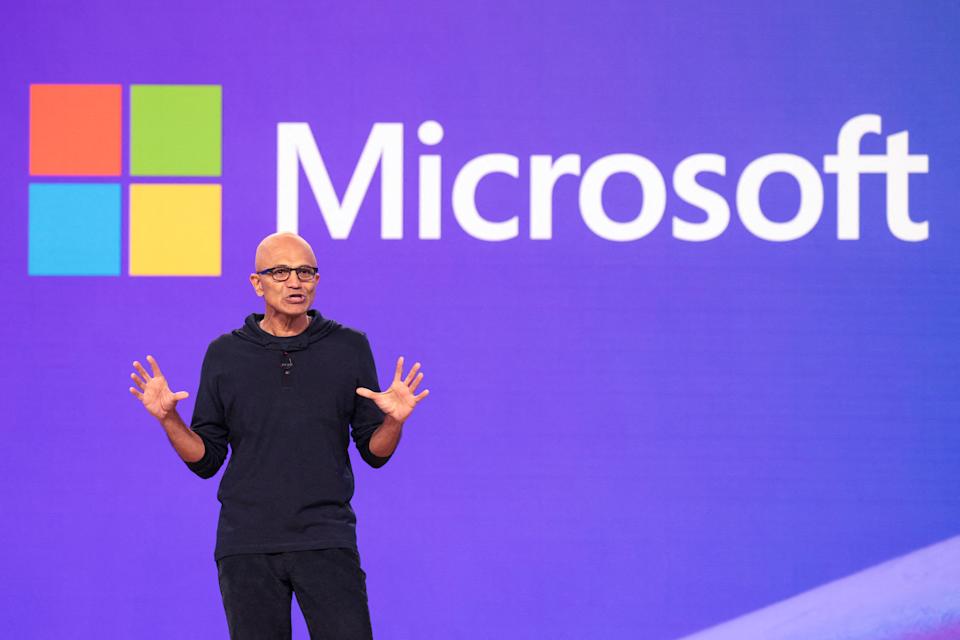 Microsoft CEO Satya Nadella has been heavily involved in the AI arms race. (Jason Redmond/AFP). JASON REDMOND via Getty Images
Microsoft beyond OpenAI
Microsoft's AI advantages stem from how it has threaded AI through every layer of its technology — from Azure and Office to developer tools, enterprise software, and consumer products like Bing and Edge.
This deep integration is most visibly represented by Copilot, Microsoft's suite of generative AI assistants, which is utilized in workflows such as productivity apps like Microsoft 365, in operating systems like Windows, and in tools like GitHub Copilot.
Logan Brown, founder of software development platform Soxton.AI, told Yahoo Finance that Microsoft's ability to integrate AI tools like Copilot across its suite of products uniquely positions it in the AI landscape.
"They [Microsoft] have such a dominating presence across their suite, they're going to be able to integrate and become a Copilot in that sense of the word." She pointed out that "most folks are renting out" Microsoft's infrastructure base.
A Microsoft spokesperson told Yahoo Finance the company is watching seven key trends in 2026 as it aims to nab a big slice of that AI pie, including amplifying human capabilities, equipping agents with better safeguards, and closing the health disparity gap.
The pace of AI innovation within Microsoft — and its massive scale — matters for investors, who increasingly see Microsoft's dependence on OpenAI easing, not rising, even as the partnership remains financially and technically important.
"From a business strategy point of view, it feels like what they're [Microsoft] doing is continuing to rely on a really, really important partner, but also hedging their bets a little bit by developing their own AI internally as well," NYU Stern professor Robert Seamans told Yahoo Finance.
 OpenAI won Yahoo Finance's annual Company of the Year award. CFO Sarah
Friar talks with Yahoo Finance Executive Editor Brian Sozzi about the
company's path forward. Yahoo Finance
OpenAI won Yahoo Finance's annual Company of the Year award. CFO Sarah
Friar talks with Yahoo Finance Executive Editor Brian Sozzi about the
company's path forward. Yahoo Finance
This "hedge" allows Microsoft to serve its "huge array of customers" with tailored AI solutions from both internal and external sources, he added.
Analysts remain split on how essential OpenAI is to the investment thesis in Microsoft at this point.
RBC analyst Rishi Jaluria argues that Microsoft still enjoys a "multiyear head start" in AI because of its early OpenAI bet, which gave it intellectual property (IP) rights, preferred pricing, and research access that helped it plant an early flag in the AI race.
"You don't want a company as powerful as Microsoft being so reliant on OpenAI," Jaluria said. In the same vein, "you don't want a company like OpenAI, that's becoming more and more powerful, to be all reliant on one company, right?"
The financial upside from OpenAI is also more limited than some investors assume.
Despite its 27% stake, Microsoft does not recognize profits from OpenAI on its income statement — only its share of losses. The only meaningful upside is the rising value of the stake, which won't matter until OpenAI goes public or becomes significantly profitable. Both are unknown outcomes.
DA Davidson analyst Gil Luria estimates that of Microsoft's total Azure revenue, only 17% comes from AI workloads. More critically, he estimates that the revenue directly tied to reselling OpenAI's models is just 6% of that total, while approximately 75% is generated from Azure AI, Microsoft's own infrastructure and services, "considering OpenAI is helping Microsoft generate revenue elsewhere," per Luria.
The financials suggest that the independent Azure AI business, not the OpenAI equity stake, is the key driver of value.
The ties that bind
The duo's revised partnership was intended to finally loosen ties — for the benefit of both.
Microsoft lost its "right of first refusal" but retained long-term IP rights through 2032, including artificial general intelligence (AGI) rights, and secured favorable application programming interfaces (API) economics. That's crucial because every time an enterprise app calls the OpenAI API — from Salesforce's (CRM) Agentforce to ServiceNow's (NOW) Now Assist — Microsoft gets paid.
An eventual OpenAI IPO could shift the balance of power between the two, but analysts aren't convinced it would materially weaken Microsoft.
At the same time, the new arrangement gives both companies permission to diversify. OpenAI can pursue deals with other cloud providers — which it has already done, through a barrage of partnerships with players like Oracle (ORCL), Advanced Micro Devices (AMD), Samsung (005930.KS), and Nvidia (NVDA).
Microsoft, meanwhile, is free to deepen work with other model providers, most notably Anthropic (ANTH.PVT). Microsoft announced a $5 billion investment commitment in Anthropic in November. Crucially, Anthropic committed to purchase $30 billion of Azure compute capacity, securing massive future revenue for Microsoft. Most recently, Microsoft said it would invest $17.5 billion in India over the next four years as it ramps up its AI roadmap.
KeyBanc analyst Jackson Ader told Yahoo Finance he sees this shift as a "move for independence" on the part of Microsoft, not a hedge.
"Going outside is fine and a good diversification strategy," he said. "I just don't see it as all that impactful, because they're still partnering with the best partner [OpenAI]."
 High demand for its AI-powered cloud services, particularly Azure and Copilot, is driving the aggressive investment.
The bottom line on Microsoft
Microsoft's ultimate advantage over the next decade, experts tell Yahoo Finance, is the breadth of its AI footprint.
RBC's Jaluria points to Azure's training and inference workloads, such as GitHub Copilot for developers and AI-infused enterprise apps through Office. Even Microsoft's LinkedIn and its Activision Blizzard gaming division carry AI-driven monetization potential.
"There's no other company with this kind of portfolio," he said. Currently, Jaluria has a Buy rating and $640 price target on Microsoft. Yahoo Finance data shows a generally bullish Wall Street on Microsoft.
The next major unlock for Microsoft, analysts believe, may be agentic AI — AI agents capable of performing multistep workflows. The firm expects Microsoft to be a top player alongside ServiceNow and Salesforce.
And while Copilot adoption remains early, Jaluria said adoption is likely to grow "slow and steady" as AI features become more deeply embedded in everyday workflows. "Office is going to be the front door," he said.
That optimism doesn't erase the risks for Microsoft on AI.
 The Street remains bullish on Microsoft shares, Yahoo Finance data shows. · Source: Yahoo Finance
A big one is overbuilding.
Microsoft previously said it was on track to spend $80 billion on AI infrastructure through fiscal 2025. Meanwhile, a separate, large-scale project with OpenAI titled Stargate, with an initial $100 billion investment, is reportedly in the early stages of planning. There have been subsequent reports that the project is now a multipartner joint venture involving the duo and other players, like SoftBank (9434.T), Oracle (ORCL), and Metagenomi (MGX), with an ultimate plan to invest up to $500 billion by 2029.
Still, investors are cautious about the rate of Microsoft's investments.
If AI demand slows or if competing models meaningfully outpace GPT, Ader warns, Microsoft could look like it "bought a Ferrari when a Prius would've done."
The second major risk is sentiment.
"If AI doesn't deliver," he said, "Microsoft will be caught up in a negative AI trade," even if its fundamentals remain strong.
Still, most analysts agree the company remains one of the strongest AI plays of the decade. OpenAI gave Microsoft a head start, but its widening network of AI partners gives the company staying power that doesn't depend on any single model.
Francisco Velasquez is a Reporter at Yahoo Finance. Follow him on LinkedIn, X, and Instagram. Story tips? Email him at francisco.velasquez@yahooinc.com.
This week top market trends.
-
Global equity funds draw inflows for ninth week on corporate earnings optimism
2025-11-21 :: stock :: reuters -
Crypto breaks higher as BOJ decision clears a macro overhang
2025-12-19 :: crypto :: coindesk -
US Readies New Russia Sanctions If Putin Rejects Peace Deal
2025-12-17 :: watchlist :: bloomberg -
China's Didi Q3 revenue up 8.6% as costly overseas expansion accelerates
2025-11-26 :: companies :: reuters -
Fed Rate Cut Disappointment: Why Crypto Market Crashed After Fed’s 25 bps Cut
2025-12-11 :: crypto :: ccn.com
Recent global market news
-

Microsoft to invest more than $5.4 billion in Canada to boost AI infrastructure
2025-12-09 :: :: reuters -

UBS Reiterates Buy on Micron (MU) Ahead of Earnings, Citing Strong AI Memory Demand
2025-12-12 :: :: insider monkey -

Analysis-Crypto investors show caution, shift to new strategies after crash
2025-12-17 :: :: reuters -
Exclusive-Tesla board made $3 billion via stock awards that dwarfed tech peers
2025-12-15 :: :: reuters