Link copied
Longtime fund manager lays out surprising S&P 500 target for 2026.
stock :: 2026-01-05 :: source - thestreet
By Todd Campbell
Louis Navellier has seen a thing or two since he began navigating the stock market in the 1980s. Navellier, the founder of Navellier & Associates, a firm with about $1 billion in assets under management, has managed money through the savings and loan crisis of the 1980s and early 1990s, the internet boom and bust, the Great Recession, the Covid pandemic, and 2022's bear market.
Over the years, he learned valuable lessons about what causes stocks to rise or fall — a knowledge that correctly kept him bullish in 2025 while others worried over tariffs, geopolitics, and a boxed-in Fed.
Effective tariff rates soared to 16.8% from 2.4% in January, the highest since 1935, according to Yale Budget Lab, contributing to a rebound of inflation. Meanwhile, tensions flared in the Middle East even as the War in Ukraine dragged on. The Fed's dual mandate kept it on the sidelines through the summer, before Chairman Powell finally cut rates at three consecutive FOMC meetings in September, October, and December, because of job losses.
In short, there's been plenty to worry about. Still, Navellier remained unfazed by it all, believing tariffs and inflation headwinds would prove temporary, clearing the way for profit-friendly rate cuts, higher GDP, and share price gains.
Navellier's market outlook for 2026 is similarly bullish. The Wall Street veteran's forecast calls for yet another year of double-digit returns.
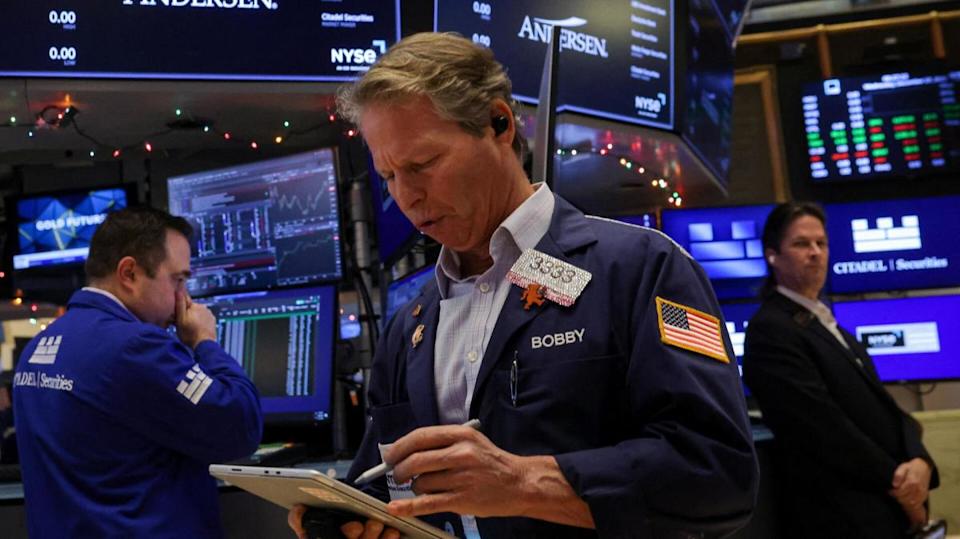 Wall Street's Louis Navellier has a bullish outlook for 2026 after three consecutive years of double-digit gains. Reuters
Longtime fund manager shares 2026 forecast
Navellier's bullishness is in sharp contrast to bear-market concerns that the U.S. economy is at risk of stagflation, a period of slow growth and higher prices, or worse, a looming recession.
The unemployment rate has ticked up to 4.6% from a low of 3.4% in 2023, according to the Bureau of Labor Statisticsunemployment report. Layoffs exceeded 1.1 million through November, up 54% from last year, according to Challenger, Gray, & Christmas. Yet, Navellier believes the Fed can still turn the corner, supporting GDP growth, the labor market, and share prices.
More Wall Street:
"There is no reason for the Fed to remain restrictive when the U.S. economy is not creating many jobs," wrote Navellier in a note shared with TheStreet. "The Fed has to cut key interest rates four more times in 2026 to move to a neutral rate, and more may be needed if deflationary pressures intensify."
His optimism for four Fed rate cuts this year contradicts the Fed's internal projections. In December, the Fed's dot-plot, which measures Fed officials' guesses for the path of interest rates, suggested just one more cut in 2026.
Navellier thinks job uncertainty will force more cuts than expected, in turn, stimulating the economy even as inflation headwinds retreat.
"Deflation, not inflation, will be the biggest challenge for the U.S. economy," said Navellier.
Navellier's expected for receding inflation is based on:
Softening home prices nationwide, with declining rents
Oil prices near five-year lows
Moderating food costs
The U.S. importing deflation from China, "and other weak global economies."
A softening of inflation, as Navellier predicts, would remove the major obstacle to more interest rate cuts than currently anticipated by Wall Street. More cuts would help stimulate the economy, reducing borrowing rates — including mortgages — while also making it easier for companies to embark on new projects by lowering the risk-free hurdle rate (Treasury yields move directionally with the Fed Funds Rate).
Bank of America core PCE inflation forecast for 2026:
Q1 2026: 3.1%
Q2 2026: 3.1%
Q3 2026: 3.1%
Q4 2026: 2.8%
Source: Bank of America "U.S. Economic and Equity Strategy Outlook, Dec. 2025"
Overall, if Navellier is correct, lower interest rates will support GDP growth, which, in turn, will boost revenue and earnings for S&P 500 companies. Stocks tend to follow earnings over time, so, assuming the Fed cooperates, Navellier thinks stocks could march significantly higher in 2026.
"GDP will grow at an annual rate of 5%," says Navellier. "The SPX will return 20% or more in 2026."
Cheap oil, AI spending provide catalysts
2025 wasn't an easy year for companies; yet, sales and profits for S&P 500 stocks have risen sharply, and Wall Street expects this trend to continue in 2026.
"The estimated (year-over-year) earnings growth rate for CY 2026 is 15.0%, which is above the trailing 10-year average (annual) earnings growth rate of 8.6% (2015 – 2024). If 15.0% is the final number for the year, it will mark the 6th consecutive year of earnings growth and 3rd consecutive year of double-digit growth," according to FactSet.
Related: Fed interest rate cut bets shift for January
Analysts expect the earnings upside to come from increased revenue and improved profit margins, despite the impact of tariffs.
Overall, I reviewed FactSet data and found that the consensus of Wall Street estimates targets full-year revenue growth of 7.2% in 2026, exceeding the average 5.3% revenue growth delivered from 2015 through 2024.
In total, FactSet's number crunching reveals that "Ten of the eleven sectors are projected to report year-over-year growth in revenues, led by the Information Technology and Communication Services sectors."
The outlook for profit margins is similarly bullish, with Wall Street expecting margins to improve to 13.9%. If so, it would be the highest annual net profit margin delivered by S&P 500 companies since FactSet began calculating the figures in 2008.
Navellier expects that cheap oil and ongoing AI investments will drive profit growth.
"Crude oil will remain above $50 per barrel and near a 5-year low," predicts Navellier, because of significant crude oil stored in oil tankers (up 24% year over year) and the possibility of significantly boosting production in Venezuela following the removal of President Nicolás Maduro Moros.
AI spending is also expected to continue this year, according to Navellier.
"The data-center boom is accelerating. Order backlogs are up roughly 20% quarter over quarter and 50-65% year over year. This investment cycle is overwhelming other sectors and will remain a major contributor to GDP growth, productivity gains, and earnings growth throughout 2026," said Navellier.
My review of Goldman Sachs data shows that hyperscalers' capital expenditures totaled $106 billion during the third quarter of 2025, up 75% from the same quarter one year ago. Goldman Sachs expects total hyperscaler spending will finish at $394 billion in 2025 and climb significantly again in 2026.
"The consensus estimate among Wall Street analysts for the group’s 2026 capital spending is now $527 billion, up from $465 billion at the start of the third-quarter earnings season," wrote Goldman Sachs analysts.
IDC said in September that business spending on AI "will have a cumulative global economic impact of $19.9 trillion through 2030 and drive 3.5% of global GDP in 2030." It concluded that every $1 spent on AI will "generate $4.60 into the global economy."
Related: Forget the Magnificent 7, it's now the Magnificent 2
This story was originally published by TheStreet .
Add TheStreet as a Preferred Source by clicking here
This week top market trends.
-
Bitcoin Climbs to Three-Week High After US Captures Maduro
2026-01-05 :: crypto :: bloomberg -
OPEC+ to keep oil output steady despite turmoil among members, sources say
2026-01-04 :: commodities :: reuters -
Bank earnings to cap banner 2025, set the table for growth in 2026: 'Everything is moving up at the same time
2026-01-13 :: stock :: yahoo finance -
Why Big Oil has a long road ahead in Venezuela, the 'fallen angel of global crude markets'
2026-01-06 :: stock :: yahoo finance -
China to probe Meta's acquisition of artificial intelligence startup Manus
2026-01-08 :: companies :: apnews
Recent global market news
-

BofA Stays Bullish on Jabil (JBL) as FY26 Outlook Exceeds Expectations.
2026-01-04 :: :: insider monkey