Reporting by Stefano Rebaudo in Milan, Ankur Banerjee in Singapore and Jiaxing Li in Hong Kong; Editing by Sonali Paul, Thomas Derpinghaus and Sharon Singleton
Reuters report
This week on Reuters
Link copied
By Stefano Rebaudo and Ankur Banerjee
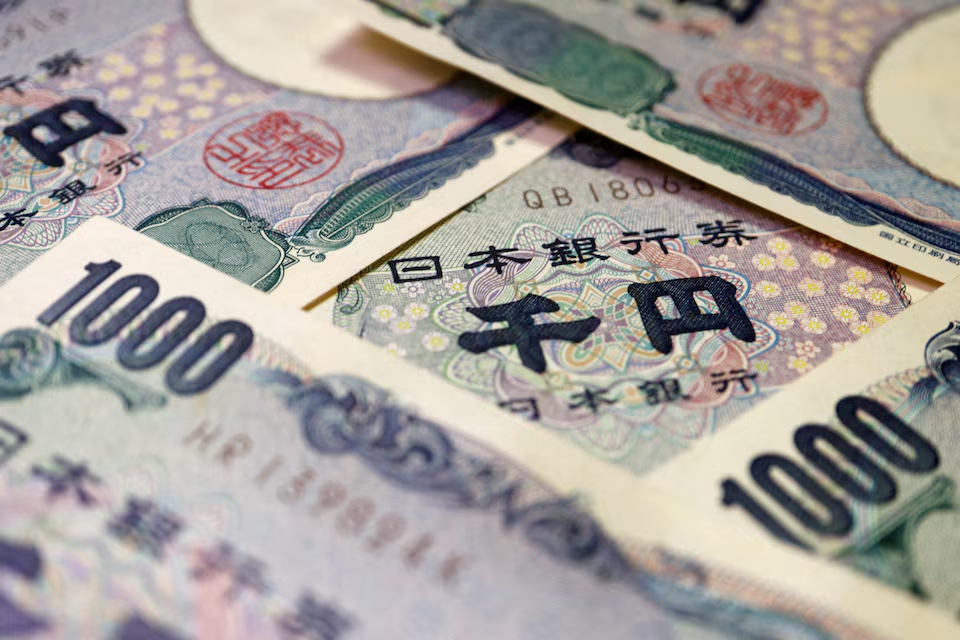
(Reuters) - The U.S. dollar extended Monday’s decline against the yen after Prime Minister Sanae Takaichi’s election victory, while remaining little changed against European currencies before key economic data due on Wednesday.
The Japanese currency snapped a six‑day losing streak on Monday after falling toward the 160 threshold against the greenback, triggering fears of intervention by Japanese authorities to support the yen.
However, analysts also noted that Takaichi’s policy, which includes tax cuts and more fiscal spending, is expected to boost the economy and lift the stock market, potentially prompting a more hawkish Bank of Japan, all factors that could support the yen.
The yen rose 0.23% to 155.52 against the dollar after jumping 0.85% the day before.
It was up 0.32% at 185.18 versus the euro after being roughly unchanged on Monday.
“With Prime Minister Sanae Takaichi moving from a relatively fiscally conservative stance to one favouring carefully targeted stimulus, the balance of risks has tilted toward additional tightening from the Bank of Japan,” said Harvey Bradley, co-head of global rates at Insight Investment, arguing that a neutral rate around 1.5% looks reasonable.
“Takaichi’s planned election is aimed at consolidating her position, but a realignment among opposition parties may complicate that ambition and should reassure markets that the fiscal outlook is not going to meaningfully deteriorate,” he added.
Political analysts had suggested that Takaichi’s strong mandate might give her room to moderate the plan, as opposition parties calling for even bolder tax cuts suffered heavy defeats at the ballot box.
Investor attention will be on the monthly reports covering U.S. employment and consumer prices that were pushed back slightly due to a recent three-day government shutdown.
White House economic adviser Kevin Hassett said on Monday that U.S. job gains could be lower in the coming months due to slower labour force growth and higher productivity. Investors are trying to assess whether weakening in the labour market has tapered off.
The dollar index , which measures the greenback against six other currencies, was roughly unchanged at 96.90, after hitting a fresh one-week low at 96.789.
European Central Bank President Christine Lagarde played down concerns that euro-dollar would influence the bank's policy path, yet the currency dynamic remains a key focus for market participants.
"I would assume that the ECB is also uncomfortable with the strong focus on the euro's appreciation and will probably only react more strongly if the appreciation becomes even more pronounced," said Michael Pfister, a forex analyst at Commerzbank. He noted that the question of what euro-dollar level might prove too high for the ECB has become the hot topic in client discussions.
The single currency stood at $1.1906 after a 0.85% jump on Monday. The dollar index , which measures the greenback against six other currencies, was at 96.79, hovering near a one-week low.
The Chinese yuan strengthened past 6.91 per dollar for the first time since May 2023, bringing the gains to more than 1% for the year, with analysts expecting the currency to rise throughout the year.
Seasonal corporate conversion demand and the central bank's stronger fixing guidance have both buoyed sentiment, while media reports that China urged local banks to diversify away from U.S. Treasuries also added to the momentum.
The Australian dollar eased 0.3% to $0.7070, just shy of a three-year top after riding a global stocks rally, while the New Zealand dollar was at $0.60395, down 0.3%.
Reporting by Stefano Rebaudo in Milan, Ankur Banerjee in Singapore and Jiaxing Li in Hong Kong; Editing by Sonali Paul, Thomas Derpinghaus and Sharon Singleton
This week on Reuters