Link copied
Oil Slides After Trump Seeks to Ease Concerns Over War’s Length.
commodities :: 10hrs ago :: source - bloomberg
By Bloomberg News
(Bloomberg) -- Oil tumbled after US President Donald Trump said the Iran war will end soon, as he faces mounting pressure over the conflict that’s upended global energy markets and sparked concerns about an inflation crisis.
Global benchmark Brent fell as much as 11% before clawing back some losses, following a dramatic session on Monday that saw the biggest intraday price swing on record. Trump’s efforts to calm the market prompted futures to retreat on Tuesday — on top of resolving the war, he would waive oil-related sanctions and get the US Navy to escort tankers through the vital Strait of Hormuz.
Most Read from Bloomberg
Trump Signals Possible End to War, Floats Removing Oil Sanctions
Stocks Climb as Trump Hints War Could Be Over Soon: Markets Wrap
Still, prices remain up almost 50% this year as fears a conflict would disrupt supplies from the Middle East increasingly materialize. Four of the region’s giants — Saudi Arabia, Iraq, the United Arab Emirates and Kuwait — have lowered their collective output by as much as 6.7 million barrels a day, with the war effectively closing the region’s main export route and causing storage tanks to fill up.
The latest price swings reflect one of the oil market’s most volatile periods on record, testing traders’ limits, with the war now in its second week. Brent was fluctuating around $91 a barrel Tuesday — a day after trading as high as $119.50 and as low as $83.66.

The conflict has sucked more than a dozen countries into the fray, and has also led to a surge in prices for natural gas and products such as diesel. US retail gasoline has jumped to the highest level since August 2024, putting additional pressure on Trump.
Crude is still far higher than before the war because of the effective closure of the Strait of Hormuz — the narrow waterway that typically handles a fifth of global oil flows. Also helping ease Monday’s spike, the world’s largest economies considered an effort to release emergency reserves.
But shipping through Hormuz is at a trickle, with attacks on multiple vessels since the war started on Feb. 28 leading most to shun the waterway. In recent days, a tanker hauling Saudi crude sailed across, while Iran has continued to ship large volumes, though trade is far from normal.
“Everything depends on how the situation in Iran evolves,” said Thu Lan Nguyen, commodity and FX research head at Commerzbank. “If the war did end in the next two weeks, I would expect the oil price to come down further.”
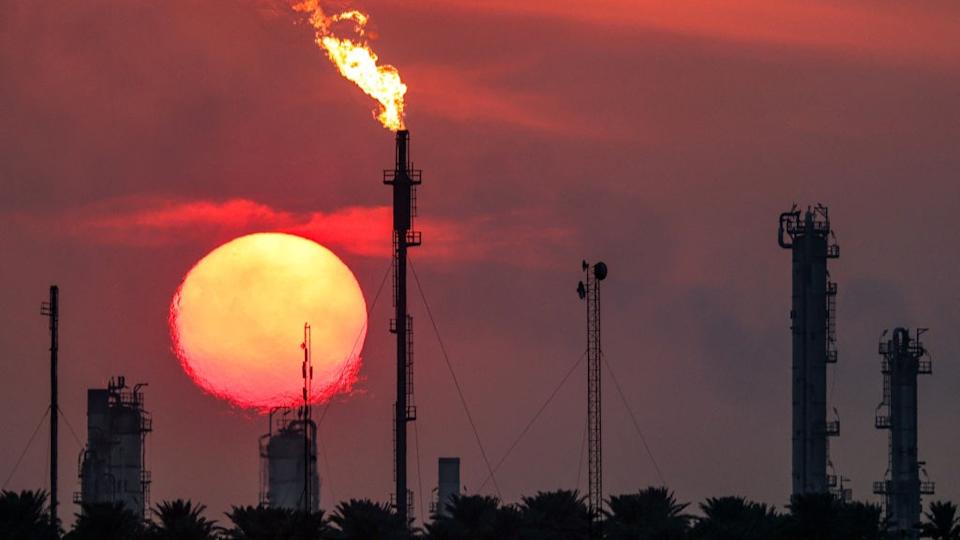 WATCH: Oil tumbled after US President Donald Trump sought to calm
markets by saying the Iran war will end soon. Stephen Stapczynski
reports. Source: Bloomberg
WATCH: Oil tumbled after US President Donald Trump sought to calm
markets by saying the Iran war will end soon. Stephen Stapczynski
reports. Source: Bloomberg
Investors have been skeptical about moves by the Trump administration to calm energy markets, but his latest remarks underscored a new willingness by the White House to publicly indicate that it could be moving to end the war.
The US president didn’t offer additional specifics on the plan to escort tankers or waive oil-related sanctions, beyond acknowledging he had discussed the topic with Russian President Vladimir Putin in a phone call earlier Monday. Last week, the Trump administration cleared the way for India to temporarily increase its purchases of Russian crude, reversing months of pressure on the trade.
“We’re looking to keep the oil prices down,” Trump said. “They went artificially up because of this excursion,” he said, adding that he did not believe the conflict would be over this week. At the same time, the US leader acknowledged unanswered questions that remained about the leadership in Tehran and vowed he would “not relent until the enemy is totally and decisively defeated.”
The start of trading for West Texas Intermediate futures on Tuesday was temporarily stalled after a circuit-breaker halt in the first two minutes, adding to the market’s stress. There was a similar circuit-breaker when trading opened on March 2 after the war began.
“It’s unprecedented, even for as volatile as oil is,” said Vikas Dwivedi, an oil and gas strategist at Macquarie Group, who characterized trading on Monday as a “crazy day.”
Most Read from Bloomberg Businessweek
This week top market trends.
-
Iran War Punctures Favored Strategy of 'Sell America, Buy Asia'
2026-03-05 :: stock :: bloomberg -
India delays U.S. trade talks after Supreme Court rejects Trump tariffs, source says
2026-02-22 :: general :: reuters -
Mining stocks are the new market darlings, fueled by geopolitical risks and AI demand
2026-03-01 :: stock :: yahoo finance

Recent global market news
-
Mining stocks are the new market darlings, fueled by geopolitical risks and AI demand
2026-03-01 :: :: yahoo finance -
Gold surges above $5,400 as demand for safe-haven asset jumps amid Iran conflict
2026-03-02 :: :: yahoo finance -

Target has another quarter of declining sales but there are signs of improvement to start 2026
2026-03-03 :: :: apnews -
Amazon's Next Big Move Into Big-Box Retail Could Be an Incredible Opportunity
2026-02-27 :: :: motley fool