By Lewis Krauskopf
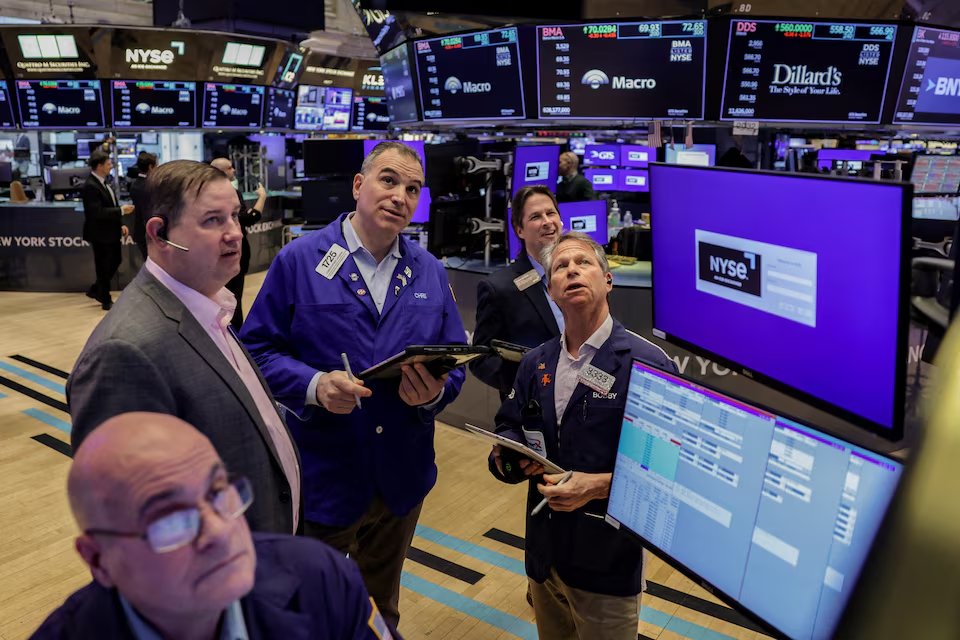 Traders work on the floor at the New York Stock Exchange (NYSE) in New York City, U.S., March 24, 2026. REUTERS/Jeenah Moon
(Reuters)
- Next week's U.S. employment report headlines a fresh batch of
economic data for stock investors, who also will closely follow
developments in an Iran war that is entering its second month.
Markets
will continue to fixate on the fallout for energy prices from the
Middle East conflict, which has choked off a big chunk of oil supplies.
U.S. crude is up more than 60% year-to-date to nearly $100 a barrel,
leading U.S. gasoline prices to surge to $4 a gallon, which could
squeeze consumer spending. As investors worried about inflation,
benchmark Treasury yields jumped to their highest since last summer,
creating a possible pressure point on equity valuations.
Sharp stock market declines on Thursday put the benchmark S&P 500 (.SPX) on pace for its fifth straight weekly drop, extending its slide to
nearly 6% since the U.S.-Israeli military strikes on Iran in late
February. The Nasdaq Composite (.IXIC) ended down more than 10% from its October all-time high, confirming it was in a correction.
During
the week, conflicting indications of potential de-escalation of the
crisis whipsawed asset prices, and stocks were likely to remain
"headline driven" in the coming days, said Jim Baird, chief investment
officer with Plante Moran Financial Advisors.
"Any
signs of positive breakthroughs in terms of discussions with Iran and a
cessation of the conflict there would go a long way towards providing
some reassurance to investors and a boost in sentiment," Baird said.
"Anything that would lead to indications that this might become more
long and drawn out, that would be a negative for investor sentiment and
certainly would weigh on the market."
Tuesday
brings an end to a rough first quarter for U.S. equities. On top of
the Iran conflict, concerns about business disruptions from artificial
intelligence and weakness in the private credit market also have rattled
stocks. The S&P 500 is down more than 5% so far in 2026, following
three straight years of solid double-digit percentage gains.
"There’s
a lot of uncertainty out there overall," said James Ragan, co-CIO and
director of investment management research at D.A. Davidson. "So as we
get into the last couple of days of the quarter, I just think you could
see the market sentiment kind of rolling over a little bit."
A POSITIVE JOBS NUMBER?
The
payrolls report for March is expected to show an estimated increase of
48,000 jobs and an unemployment rate of 4.5%, according to Reuters
data. The report is due on April 3, when U.S. stock markets will be
closed for the Good Friday holiday.
The
prior report for February was surprisingly weak, showing a decline of
92,000 jobs. Given that two of the past three monthly reports yielded
negative job growth, "any positive number would probably be good for the
market," Ragan said.
Retail sales data for February and reports on manufacturing and services activity are also due next week.
Worries
about a deteriorating labor market prompted the Federal Reserve to cut
interest rates last year. But the U.S. central bank will face a bind if
more severe employment concerns arise.
Inflation
was already above the Fed's target, so surging energy prices present an
obstacle to further rate cuts. Now, markets are factoring in no more
rate cuts for this year, with fed funds futures actually pricing in a
modest chance of a hike in 2026, according to LSEG data as of Thursday.
RISING YIELDS, FALLING VALUATIONS
Meanwhile, the benchmark 10-year Treasury yield has climbed to 4.4% from about 4% before the war started.
"The
equity market is also taking very careful notice" of the rise in
yields, said David Bianco, Americas chief investment officer at DWS.
"This affects so many things," he said, including mortgages, the debt
sustainability of the U.S. government and what is a fair
price-to-earnings valuation.
Indeed,
the market's valuation has moderated in recent weeks. The S&P 500's
P/E ratio, based on earnings estimates for the next 12 months, was last
just under 20, down from over 22 at the start of the year, according to
LSEG Datastream. That P/E ratio remains well above its long-term
average of 16.
Investors
are seeking to understand implications for corporate profits from the
war and the resulting surge in energy prices. In the face of higher
fuel and other costs, companies such as Delta Air Lines (DAL.N) and FedEx (FDX.N) recently had reports that encouraged investors. Nike (NKE.N) will post quarterly results on Tuesday, while the bulk of first-quarter results are a couple of weeks away.
"I
think the U.S. economy remains a safe distance from recession," Bianco
said. "We can debate the odds of recession going up as oil prices go
up, but I still think we are a safe distance from a recession being
likely."
Reporting by Lewis Krauskopf, editing by Colin Barr and David Gregorio
This week on Reuters