Link copied
Delta beats on Q1 earnings, maintains guidance despite fuel spike, TSA headwinds.
companies :: 4hrs ago :: source - yahoo finance
By Pras Subramanian
Delta Air Lines (DAL) posted upbeat first quarter results Wednesday morning, saying growth in the premium business will continue to deflect major concerns such as fuel costs and the ongoing government shutdown affecting TSA workers.
For the quarter, Delta posted Q1 adjusted revenue of $14.2 billion versus $14.11 billion expected, per Bloomberg consensus. The results were up 9.4% compared to a year ago, slightly above new guidance issued in March, which saw approximately 7% to 9% growth.
Delta’s adjusted earnings per share (EPS) came in at $0.64 versus the $0.57 expected, with operating income of $652 million and an operating margin of 4.6%
Fuel expenses in the first quarter came in at $2.591 billion, up 8% compared to a year ago.
Looking ahead, Delta projects Q2 revenue to grow in the “low teens,” with operating margin in the 6% to 8% range and adjusted EPS of $1 to $1.50.
Delta also projects pretax profit of “around $1 billion,” despite a more than $2 billion increase in fuel expenses seen in Q2.
Delta said this projection assumes fuel at a “forward curve as of April 2nd” and includes a refinery benefit of approximately $300 million.
Read more: $100 oil could send airfare soaring this summer. These tips could save you.
Delta said it is too early to update full-year 2026 projections. At the end of the fourth quarter, Delta saw full-year adjusted EPS of $6.50 to $7.50, representing a 20% year-over-year jump at the midpoint, with free cash flow in the range of $3 billion to $4 billion.
“We’re not walking it back,” Delta CEO Ed Bastian said on a press roundtable with reporters, just that there would be no updates to it.
 The Federal Reserve of St Louis's one-year chart of jet fuel prices. FRED, US IEA
“The question of not just the day, of the month, is going to be how we navigate this higher fuel environment brought on by the Iranian conflict,” he said, adding that jet fuel costs have more than doubled over the past 30 days.
Bastian noted that demand remains strong, and Delta is taking actions to protect margins and cash flow. The airline has reduced capacity growth and cut flights in low-traffic markets as well as midweek flights, raised prices and bag fees, and is moving quickly to “recapture higher fuel costs.”
Read more: Find the best travel credit cards for April 2026
Bastian said Delta benefits from owning the Monroe refinery outside of Philadelphia, a major advantage given that it and other airlines no longer use fuel hedges.
“And while the recent fuel spike is currently impacting earnings, I’m confident this environment ultimately reinforces Delta’s leadership and accelerates long-term earnings power,” he said.
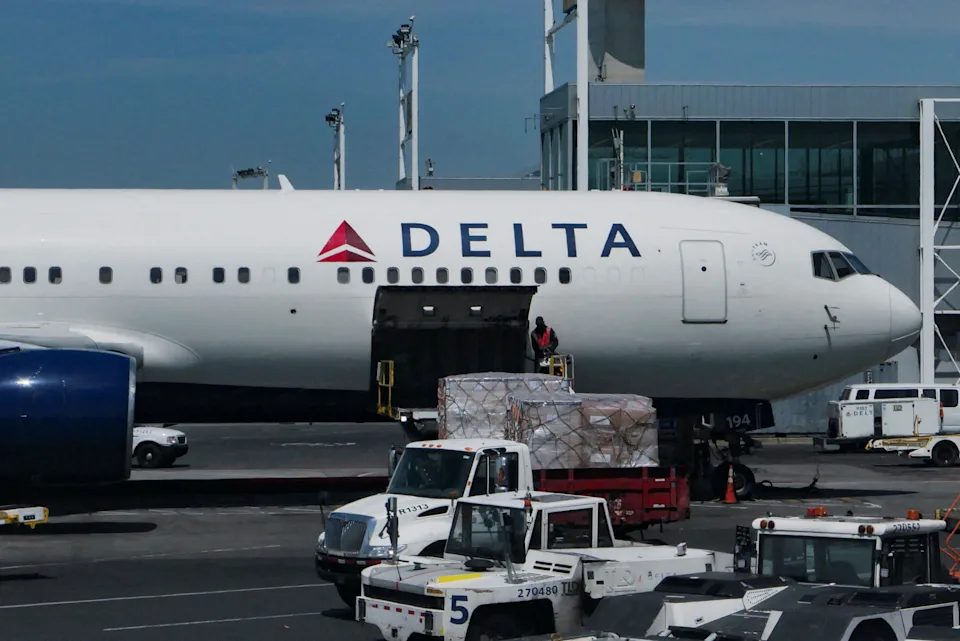 A staff member loads packages onto a Delta Air Lines plane at John F.
Kennedy International Airport in Queens, New York, on April 23, 2025.
(Reuters/Jeenah Moon)
A staff member loads packages onto a Delta Air Lines plane at John F.
Kennedy International Airport in Queens, New York, on April 23, 2025.
(Reuters/Jeenah Moon)
By owning its refinery, Delta actually benefits when the “crack spread” — the difference between the price of crude oil and refined products — widens, because it can make refined products like jet fuel on its own.
Outside of the refinery benefits, Delta’s growth was once again driven by increased business from its premium-focused, higher-net-income clients.
The closely watched total adjusted revenue per available seat mile (TRASM) came in at $0.2292 cents, up 8.2% and benefiting from those higher-margin premium customers.
Delta said Premium revenue grew 14% compared to a year ago, with loyalty and related revenue climbing 13% as well. American Express remuneration came in at over $2 billion, up 10% over the prior year.
Last year, American Express (AXP) card remuneration, a huge business for Delta and premium airlines, grew 11% ito $8.2 billion, driven by co-branded spending on cards like the Delta Platinum Reserve. Bastian said he expected “high-single-digit growth” in 2026.
 Passengers wait in long TSA lines amid a funding standoff that forced
50,000 airport security officers to go without pay, causing delays at
airports, at the George Bush Intercontinental Airport in Houston on
March 25, 2026. (Reuters/Antranik Tavitian)
Passengers wait in long TSA lines amid a funding standoff that forced
50,000 airport security officers to go without pay, causing delays at
airports, at the George Bush Intercontinental Airport in Houston on
March 25, 2026. (Reuters/Antranik Tavitian)
Bastian wouldn’t comment on how much Delta was impacted by the Department of Homeland Security funding impasse that saw workers get some back pay via an executive order but leaves future paychecks in doubt, but he said the impact was felt in the “latter weeks of March,” especially with business travelers flying short distances.
Bastian said the situation needs to be resolved. “We have been very vocal about the need to pay our security officers,” he said.
Finally, Delta and Bastian feel the airline’s operations are streamlined and efficient enough to weather higher fuel prices, but some competitors may get pinched.
“I think high fuel prices, more than any other factor, have created that sense of urgency amongst the industry to either improve through performance, improve through rationalization, improve through consolidation, or face being eliminated, because this is an extreme move at a higher level than we have seen in the past,” he said.
Pras Subramanian is the Lead Transportation Reporter for Yahoo Finance. You can follow him on X and on Instagram.
This week top market trends.
-
SEC says most crypto assets may not be securities under federal law
2026-03-19 :: crypto :: cointelegraph -
$200 billion for the war in Iran? Trump calls it a 'small price to pay.'
2026-03-20 :: watchlist :: yahoo finance -
Alibaba’s 67% Profit Plunge Shows Urgent Need to Monetize AI
2026-03-19 :: companies :: bloomberg