Link copied
Warren Buffett's Successor, Greg Abel, Has 79% of Berkshire Hathaway's $318 Billion of Invested Assets Put to Work in Just 10 Stocks.
investing ideas :: 9hrs ago :: source - motley fool
By Sean Williams, The Motley Fool
For the first time in well over half a century, Wall Street's trillion-dollar conglomerate, Berkshire Hathaway (NYSE: BRKA)(NYSE: BRKB), is in uncharted territory.
On Dec. 31, Warren Buffett officially retired from his multidecade role as Berkshire's CEO and handed the reins to his predetermined successor, Greg Abel. Although Buffett remains chairman of the board, Berkshire's day-to-day operations, including the oversight of its $318 billion investment portfolio, fall to Abel.
Will AI create the world's first trillionaire? Our team just released a report on the one little-known company, called an "Indispensable Monopoly" providing the critical technology Nvidia and Intel both need. Continue »
In many respects, Abel has vowed to walk in the Oracle of Omaha's footsteps. Abel and Buffett were cut from the same cloth in the sense that they value companies with strong management teams, sustainable competitive advantages, and robust capital-return programs.
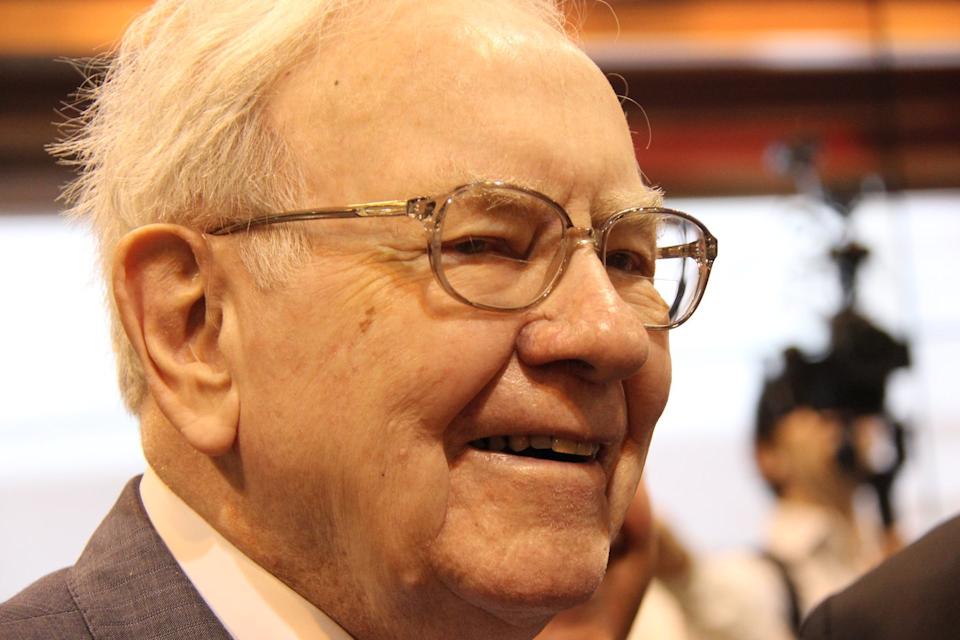 Warren Buffett retired as Berkshire Hathaway CEO on Dec. 31, 2025. Image source: The Motley Fool.
Additionally, both Abel and Buffett believe in allocating significant invested capital to their best ideas. In other words, they tend to oversee highly concentrated investment portfolios.
Nearly four-fifths of Berkshire Hathaway's portfolio is invested in these 10 stocks
Although Abel has been getting his feet wet and making moves in Berkshire's $318 billion investment portfolio following the Oracle of Omaha's retirement, he inherited a top-heavy portfolio that's packed with brand-name businesses from the U.S. and Japan.
As of the closing bell on April 10, the following 10 positions accounted for 79% of Berkshire's invested assets:
Apple (NASDAQ: AAPL): $59.4 billion (18.7% of invested assets)
American Express (NYSE: AXP): $47.5 billion (14.9%)
Coca-Cola (NYSE: KO): $31 billion (9.7%)
Bank of America (NYSE: BAC): $27.2 billion (8.5%)
Chevron (NYSE: CVX): $24.5 billion (7.7%)
Occidental Petroleum (NYSE: OXY): $15.4 billion (4.8%)
Mitsubishi (OTC: MSBHF): $13 billion (4.1%)
Mitsui (OTC: MITSF): $11.5 billion (3.6%)
Chubb (NYSE: CB): $11.2 billion (3.5%)
Moody's (NYSE: MCO): $10.5 billion (3.3%)
These "best ideas" being overseen by Abel share a couple of common themes.
Capital-return programs are king
If there's a prevailing theme that sums up Berkshire's top-10 holdings under Greg Abel (and formerly Warren Buffett), it's that robust capital-return programs rule the roost.
Public companies have two core ways to boost shareholder value beyond share price appreciation: dividends and share buybacks. All 10 of Berkshire's largest holdings by market value are currently paying a dividend to their shareholders.
What makes some of these positions highly attractive from a dividend-income perspective is their respective yields on cost (i.e., annual payout divided by Berkshire's cost basis in a company). Thanks to Berkshire's ultra-low cost basis of approximately $3.25 per share in Coca-Cola, Abel's company is netting a 63% annual yield relative to cost. It's a similar story with American Express and Moody's, which are generating yields on cost of 45% and 41%, respectively.
However, Buffett and Abel have also been longtime fans of share repurchase programs. Share buybacks can boost a company's earnings per share (EPS) and incentivize long-term investing -- something Buffett held near and dear.
Berkshire's No. 1 holding by market value, Apple, has the largest share buyback program on Wall Street. Since initiating buybacks in fiscal 2013, Apple has spent approximately $841 billion to retire more than 44% of its outstanding shares. There's little question that its repurchase program has provided a sizable boost to its EPS.
Oil stocks are known for their hearty buyback program, too. Chevron's board authorized a $75 billion repurchase program in January 2023.
 Image source: Getty Images.
Forever holdings aren't going anywhere
A second theme worth noting is that many of Berkshire's largest investment holdings are companies that Warren Buffett or Abel identified as indefinite holdings.
In Buffett's 2023 annual letter to shareholders (released in early 2024), he outlined eight companies viewed as "indefinite" positions. Coca-Cola and American Express, which have been continuously held since 1988 and 1991, respectively, made the list. Additionally, Buffett talked up Occidental Petroleum and all five Japanese trading houses, including Mitsubishi and Mitsui, as forever holdings.
In Abel's first annual letter to shareholders, he added two new names to this list: credit-ratings agency Moody's and No. 1 holding Apple.
Of note, Bank of America, Chevron, and Chubb weren't mentioned in the same light as the above seven companies. Investors should consider them long-term holdings and perhaps core positions under Greg Abel -- but far from a lock to remain in Berkshire's portfolio for decades to come.
However, value is of the utmost importance
Although capital-return programs are great, there's nothing that bears more importance to the Oracle of Omaha, and it would appear Greg Abel, as well, than getting a good deal. Value is of the utmost importance, which is why we're witnessing two of the company's largest holdings pared down with regularity over the last two years.
Between Sept. 30, 2023, and Dec. 31, 2025, Buffett and his understudy green-lit the sale of approximately 687.6 million shares of Apple, equating to roughly 75% of Berkshire's former stake. While Abel views Apple as a multidecade compounder, shares of the company ended last week at a trailing 12-month price-to-earnings (P/E) ratio of 33!
 AAPL PE Ratio data by YCharts.
To put this into perspective, Apple shares were hovering at a P/E ratio of 10 to 15 when Buffett was initially building up his company's position during the first quarter of 2016. Apple may be a golden goose for Abel, but its historically priciness suggests additional selling may be in the offing.
But Apple isn't alone. From mid-July 2024 through Buffett's retirement, Form 13F filings show that Buffett dumped roughly half of Berkshire's Bank of America stake (515.6 million shares).
The reason for this selling likely has to do with value, once again. When Buffett initially invested in BofA preferred stock in August 2011, Bank of America's common stock was trading 62% below its book value. When 2025 ended, BofA shares were trading at a 43% premium to book value.
Nothing will ever be more important to Berkshire's former or current CEO than getting a good deal.
Should you buy stock in Apple right now?
Before you buy stock in Apple, consider this:
The Motley Fool Stock Advisor analyst team just identified what they believe are the 10 best stocks for investors to buy now… and Apple wasn’t one of them. The 10 stocks that made the cut could produce monster returns in the coming years.
Consider when Netflix made this list on December 17, 2004... if you invested $1,000 at the time of our recommendation, you’d have $573,160!* Or when Nvidia made this list on April 15, 2005... if you invested $1,000 at the time of our recommendation, you’d have $1,204,712!*
Now, it’s worth noting Stock Advisor’s total average return is 1,002% — a market-crushing outperformance compared to 195% for the S&P 500. Don't miss the latest top 10 list, available with Stock Advisor, and join an investing community built by individual investors for individual investors.
*Stock Advisor returns as of April 16, 2026.
Bank of America is an advertising partner of Motley Fool Money. American Express is an advertising partner of Motley Fool Money. Sean Williams has positions in Bank of America. The Motley Fool has positions in and recommends Apple, Berkshire Hathaway, Chevron, and Moody's and is short shares of Apple. The Motley Fool recommends Occidental Petroleum. The Motley Fool has a disclosure policy.
This article was originally published by The Motley Fool
This week top market trends.
-
US gas prices top $4 a gallon for first time since 2022 as Iran war drags on
2026-03-31 :: commodities :: yahoo finance -
3 charts reveal Big Tech's biggest problem this earnings season
2026-04-09 :: stock :: yahoo finance -
Nvidia GTC 2026: What to expect from Nvidia's biggest event of the year
2026-03-16 :: companies :: yahoo finance
Recent global market news
-
'Mild stagflation': Bank of America rips up economic forecasts, braces for $100 oil all year on Iran war disruptions
2026-04-02 :: :: yahoo finance -
Wall Street bank earnings in five charts as volatile markets take center stage
7hrs ago :: :: reuters -
Millionaires in America: How common is it to have a 7-figure net worth?
2026-04-06 :: :: yahoo finance