By Jeremy Bowman
SpaceX filed confidentially to go public at the beginning of April, and its IPO is set to shatter market records.
The Elon Musk-led company is reportedly targeting a valuation of as much as to $2 trillion and raising up to $75 billion.
SpaceX has been one of the most eagerly awaited IPOs, along with
OpenAI and Anthropic, but it's not the winning investment you might
think it is.
Based on revenue of approximately $15.5 billion-$16 billion last
year, SpaceX could debut at a price-to-sales ratio of more than 100,
which would make it far more expensive than any stock on the S&P 500, even Palantir, which currently trades at a P/S ratio of 77.
SpaceX
could fetch that valuation because of Elon Musk's visionary leadership
and the company's bold goals of achieving things like colonizing Mars
and sending data centers into space, as dubious as they might be. The
company is widely considered the leader in modern rocket technology and
pioneered the use of reusable rockets, which have significantly lower
costs. Meanwhile, Starlink, its satellite internet division, is the
leader in that industry and is the source of most of SpaceX's revenue.
The company also owns xAI, following a merger earlier this year, which
owns the X social media site and the Grok AI chatbot.
However, SpaceX's valuation could be a bitter pill to swallow and is
likely to pressure the stock once it goes public. One stock that looks
like a better alternative to SpaceX is Amazon (AMZN).
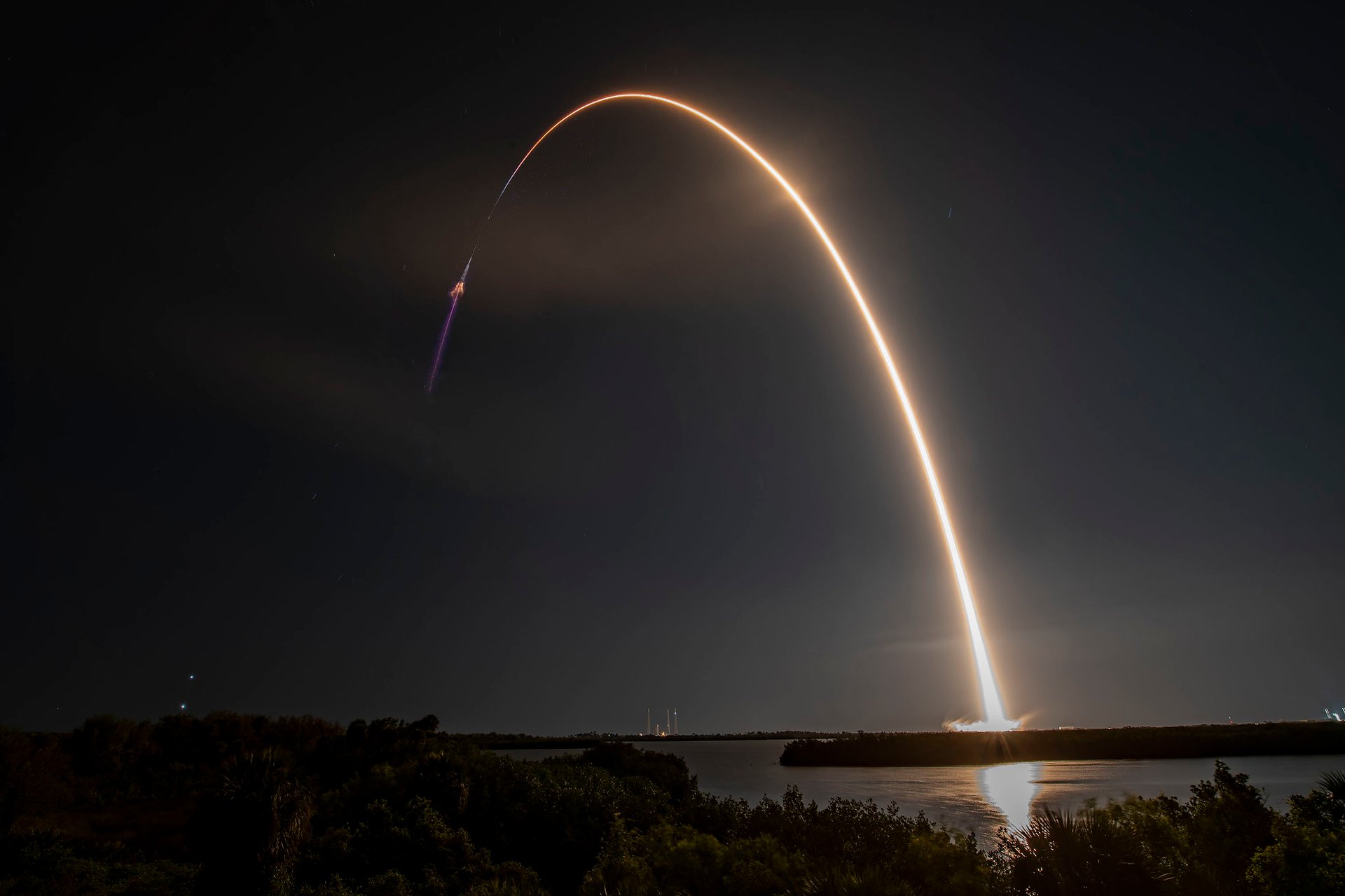 Image source: SpaceX.
How Amazon stacks up with SpaceX
What's attractive about Amazon in comparison to SpaceX is that Amazon
Leo, formerly known as Project Kuiper, is considered Starlink's closest
competitor.
Amazon has launched hundreds of satellites into orbit and is
currently providing an enterprise beta service for select business
partners as it tests its service, meaning Leo is currently only
generating minimal revenue.
However, Leo is believed to be on the verge of commercial service, and JetBlue said
it would be the first airline to use Amazon Leo for in-flight Wi-Fi
starting next year, a sign that Amazon will likely be selling to other
customers. The company also showed it's serious about the satellite
internet business with its $11.6 billion acquisition of Globalstar earlier this month.
Amazon doesn't have a rocket business like SpaceX, but Founder Jeff
Bezos owns Blue Origin, another space technology company, and it's easy
to see a merger between it and Amazon happening if the rocket business
were seen as attractive enough.
Amazon isn't considered a major competitor in frontier models, but it is a major investor in Anthropic.
After investing $8 billion in Anthropic earlier, it has just reached a
deal with the AI start-up to invest $5 billion now, with up to $20
billion more in the future as milestones are reached. For investors
looking for exposure to AI, that could be more attractive than SpaceX's
ownership of xAI.
What else Amazon owns
Of course, Amazon's value comes from its dominance in e-commerce and
cloud computing, which made it the biggest company in the world by
revenue in 2025, and generated $77.7 billion in generally accepted
accounting principles (GAAP) net income.
Amazon has a market cap of $2.8 trillion currently and trades at a
price-to-earnings ratio of 36, meaning that investors are getting
ownership of one of the most dominant companies in the tech industry,
with emerging growth opportunities and its stake in Anthropic virtually
for free.
Amazon's net income was roughly five times larger than SpaceX's
revenue last year, yet SpaceX is targeting a valuation that's only about
a third less than Amazon. It seems hard to justify SpaceX's valuation
when you look at it that way.
While SpaceX is certainly doing some exciting things with rockets and
satellites, the valuation seems unsustainable. If you're looking for
exposure to those businesses without the risk, Amazon looks like the
much better choice.
CEO says this is worth 18 Nvidias. Will this make the world's first trillionaire?
Nvidia’s CEO just revealed that one breakthrough could create more
millionaires in the next five years than the internet did in two
decades.
Amazon’s Jeff Bezos says it is “hard to overstate the impact.” And
Cathie Wood projects AI could be an $80 trillion opportunity by
2030. That is the equivalent of 18 Nvidias, 29 Microsofts, or 35 Amazons.
But here’s what most investors miss: almost all that growth runs
through a single choke point. One little-known company, called an
“Indispensable Monopoly,” provides the critical technology Nvidia, AMD,
and Intel cannot function without. And it is still just a fraction of
Nvidia’s size. We just released a brand-new report with the full story
and the company’s name.
Continue »
Jeremy Bowman
has positions in Amazon. The Motley Fool has positions in and
recommends Amazon and Palantir Technologies. The Motley Fool has a disclosure policy.
This article was first published by The Motley Fool