Link copied
Rivian reports smaller Q1 loss than expected, reaffirms outlook.
companies :: 2hrs ago :: source - yahoo finance
By Pras Subramanian
Rivian (RIVN) reported first quarter earnings results that largely met expectations on Thursday as the pure-play EV maker navigates the launch of its highly anticipated R2 midsize SUV while managing its cash burn and vehicle production.
The company also announced tweaks to its upcoming Georgia facility, with the Department of Energy (DOE) shrinking its loan commitment.
Shares in Rivian fell over 4% in premarket trading on Friday as investors assessed its report.
For the quarter, Rivian reported revenue of $1.38 billion versus $1.39 billion, per Bloomberg consensus estimates, up 11% compared to a year ago. Rivian posted a loss per share of $0.33 versus the $0.72 expected. Adjusted EBITDA (earnings before interest, taxes, depreciation, and amortization) came in at a loss of $472 million, wider than last year, but Rivian reported a gross profit of $119 million, its third quarter in a row.
The company said its automotive segment posted a gross profit loss, but its software and services segment posted a $180 million gross profit, with a nearly 60% gain from a year ago.
Read more: Live coverage of corporate earnings
Rivian maintained its full-year projections, seeing an adjusted EBITDA loss for 2026 in a range of $1.80 billion to $2.10 billion, with capital expenditures of $1.95 billion to $2.05 billion.
Last week, the company announced the start of production for the R2 at its plant in Normal, Ill., with customer deliveries starting “later this spring.”
“We're now ramping production, starting deliveries here very, very soon, beyond employees, but to to customers, and making sure we manage that through getting the suppliers ready, getting the plant ready, the product ready,” CEO RJ Scaringe said in an interview with Yahoo Finance.
The R2 ramp will primarily occur in Q3 and Q4, Scaringe said, and the benefits for the company will be immense.
“With the increase in volume, you have more fixed cost absorption, so the cost of goods sold will come down meaningfully. The margin structure will start to shine through,” he said.
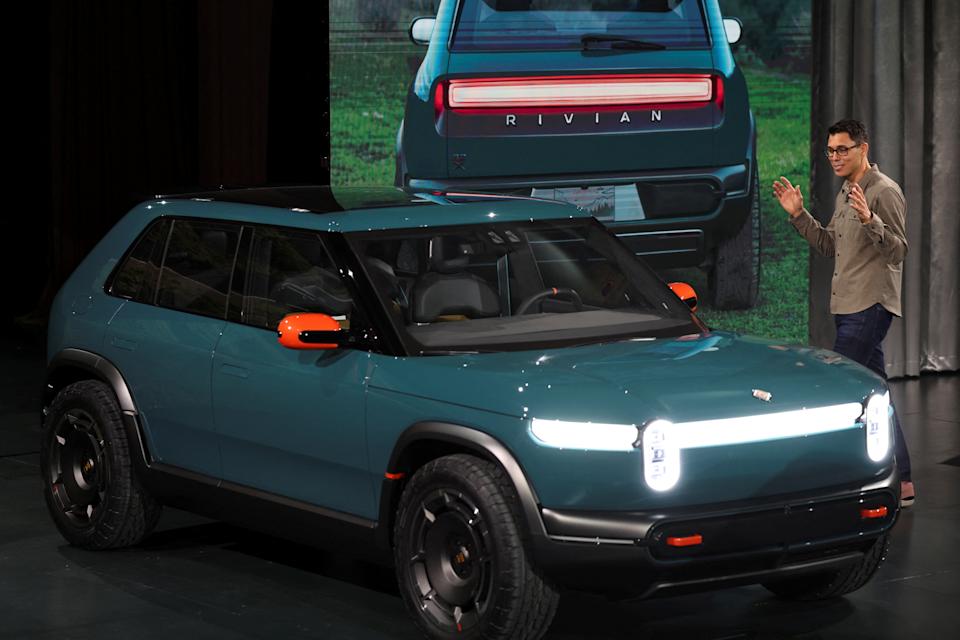 Rivian CEO RJ Scaringe speaks next to a R3X SUV, during an event to
unveil R2 SUV in Laguna Beach, California, U.S., March 7, 2024.
REUTERS/Mike Blake
Rivian CEO RJ Scaringe speaks next to a R3X SUV, during an event to
unveil R2 SUV in Laguna Beach, California, U.S., March 7, 2024.
REUTERS/Mike Blake
Read more: Buying an electric car? What to know about EV insurance costs.
Separately, the company announced that it will increase the initial capacity of its upcoming Georgia assembly plant by 50% to 300,000 units, with construction to start in 2026. However, the DOE loan that Rivian will receive is now smaller, from $6.6 billion to around $4.5 billion, and the company will start drawing on it in 2027, with a production start goal of late 2028.
The past loan commitment of $6.6 billion had Rivian tapping the funding in 2028, meaning the new deal allows the company to access the government loan sooner.
“Accessing those dollars sooner and faster is going to be helpful to get more capacity, more volume sooner,” Scaringe said. “The first phase is going from 200,000 units up 50% to 300,000 units, and a lot of work went into renegotiating the Department of Energy loan to facilitate that.”
Scaringe added that after the first phase is live and up and running, that puts Rivian at over 500,000 units of capacity, which would support positive free cash flow.
 Rivian R2 EVs at South by Southwest in Austin earlier in March. Rivian
In terms of current production, the company is producing and selling its larger R1T and R1S EVs and its EDV delivery vehicles. Earlier this month, the company announced it produced 10,236 vehicles and delivered 10,365 vehicles in Q1. Crucially, Rivian reaffirmed its 2026 delivery range guidance of 62,000 to 67,000 vehicles.
For comparison, last year the company reported an adjusted EBITDA loss of $2.063 billion, with capital expenditures hitting $1.71 billion.
Rivian’s cash stockpile will be another key metric to watch. Last month, Rivian announced it had unlocked another $1 billion in investment from its JV partner Volkswagen. The cash comes as the two companies successfully tested the first vehicle coming from the JV: the VW ID.EVERY1, which includes Rivian software and platform tech.
Also in March, Rivian announced a robotaxi deal with Uber (UBER). In exchange for $1.25 billion in investment, Uber will receive up to 50,000 autonomous R2 EVs.
Rivian ended Q1 with $4.83 billion in cash, cash equivalents, and short-term investments, and $5.39 billion in total liquidity. At the end of Q4, Rivian’s cash and cash equivalents tallied $6.082 billion, and it had $6.59 billion in total liquidity at the time.
“Volkswagen and Uber, plus the Department of Energy loan, plus our existing cash, that puts us at $13.6 billion of accessible liquidity as we go through all the ramp up activities we've just talked about over the next several years,” Scaringe said.
Pras Subramanian is Lead Auto Reporter for Yahoo Finance. You can follow him on X and on Instagram.
This week top market trends.
-
Why April 10 Could Be a Big Day for the Stock Market
2026-04-07 :: stock :: motley fool -
Amazon Fuels Record First Quarter for Company Bond Sales in EMEA
2026-04-01 :: companies :: bloomberg -
Israel and Lebanon Will Extend Their Ceasefire, Trump Says
2026-04-24 :: general :: bloomberg
Recent global market news
-

The Hedge Fund Manager Who Called Carvana's 100x Move Thinks This Mid-Cap Fintech Could Be the Next Parabolic Stock
2026-04-20 :: :: motley fool -

Seagate forecasts upbeat quarter as AI boom powers strong data-storage demand
2026-04-29 :: :: Reuters