By Anthony Di Pizio
Warren Buffett served as the CEO of the Berkshire Hathaway (BRKA )(BRKB)
holding company from 1965 to 2025. It became a trillion-dollar
conglomerate under his leadership, with numerous wholly owned
subsidiaries and a $300 billion portfolio of publicly traded stocks and
securities.
At the start of 2026, Buffett handed the reins to his chosen
successor, Greg Abel, who has some big shoes to fill. Abel kicked off
his tenure by purchasing $235 million worth of his predecessor's
favorite stock -- but you won't find it in Berkshire's portfolio. Read
on.
 Image source: The Motley Fool.
Buffett's simple investment strategy produced incredible returns
Berkshire Hathaway
was a struggling textiles company when Buffett acquired a controlling
stake in 1965. After realizing its core business wasn't viable, he
converted it into a holding company for his various investments. He
poured money into many different companies since then, focusing on those
with steady growth, reliable profits, and strong management teams.
Buffett particularly liked companies that returned money to shareholders through dividends and stock buybacks, because they compounded Berkshire's returns significantly faster. One example is Coca-Cola (KO);
Buffett spent $1.3 billion to acquire 400 million shares in the
beverage giant between 1988 and 1994, and he never sold a single one.
The position is now worth $32 billion, and it paid Berkshire $816
million in dividends last year alone.
Apple (AAPL)
is another example. Buffett invested approximately $38 billion in the
iPhone maker between 2016 and 2023, and the position was valued at over
$170 billion at the start of 2024. At that point, Apple represented half
the value of Berkshire's entire stock portfolio, so Buffett and his
managers sold three-quarters of the position by the end of 2025 to
reduce risk and lock in gains.
Buffett was also very active in the private markets during his
60-year tenure. He bought entire insurance companies, logistics
companies, and utilities, which continue to fund Berkshire's other
investments through their consistent annual cash flow.
Berkshire stock produced a compound annual return of 19.7% between 1965
and 2025, trouncing the average annual return of 10.5% in the S&P 500 (^GSPC)
index over the same period. In dollar terms, $1,000 invested in
Berkshire stock in 1965 would have been worth $48.5 million by the end
of 2025, while the same investment in the S&P would have grown to
just $399,702.
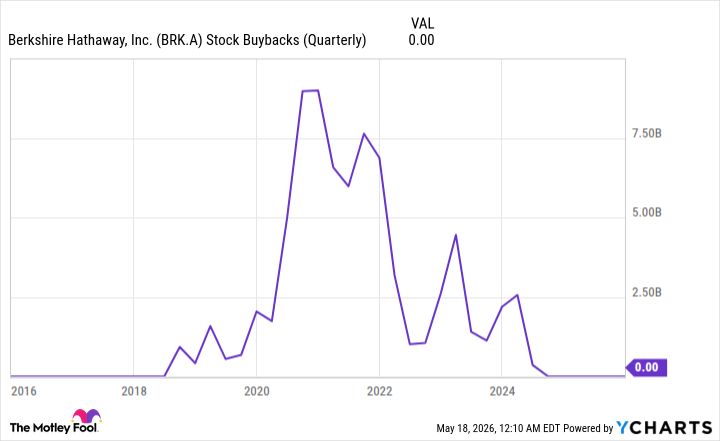
Buffett plowed $77.8 billion into Berkshire stock between 2018 and 2024
Apple remains Berkshire's largest position, and $38 billion is more
money than Buffett ever invested in any other company. However, between
2018 and 2024, he plowed $77.8 billion into another stock that you won't
find in the conglomerate's portfolio -- Berkshire itself.
Berkshire has become so large that its portfolio managers have
struggled to find new investment opportunities that are big enough to
actually move the needle. Therefore, in the final years of his tenure,
Buffett opted to return some of the conglomerate's idle cash to
shareholders instead, and stock buybacks were his chosen method.
Buffett would authorize Berkshire to purchase its own shares on the
open market, which would shrink the available float and, in turn, give
existing shareholders a larger slice of the company. Buybacks give
investors more control over when they realize their gains for tax
purposes, compared to alternatives such as dividend payments, which are taxed almost immediately.
But after authorizing $77.8 billion worth of buybacks between 2018 and 2024, Buffett didn't authorize any buybacks in 2025, much to the surprise of investors.
There are a couple of
plausible reasons why. First, Berkshire stock set multiple new record
highs in 2025, and as a value investor, Buffett probably wanted to wait
for a better opportunity. Second, he knew he would step aside at the end
of the year, so he may have wanted to leave important executive
decisions, such as stock buybacks, to his successor, Abel.
Greg Abel just restarted the buyback machine
Berkshire can engage in stock buybacks at management's discretion, as
long as the value of its cash, cash equivalents, and holdings in
government Treasury bonds remains above $30 billion. Since the company
entered 2026 with more than $360 billion in dry powder, Abel had
everything he needed to pick up where Buffett left off in 2024.
During the first quarter of 2026, which ended March 31, Abel
authorized $235 million worth of buybacks. While that isn't a huge
number, it signals his willingness to return money to shareholders,
which could bode well for Berkshire's returns during his tenure.
Only time will tell whether Abel will be as aggressive as Buffett
when it comes to buybacks, but considering the conglomerate's cash pile
ballooned to over $397 billion during the first quarter, he certainly
has room to up the ante from here -- especially if he can't identify any
major acquisition opportunities in the near future.
Is Berkshire Hathaway a long-term buy right now?
Before you buy stock in Berkshire Hathaway, consider this:
The Motley Fool Stock Advisor analyst team just identified what they believe are the 10 best stocks for investors to buy now… and Berkshire Hathaway wasn’t one of them. The 10 stocks that made the cut could produce monster returns in the coming years.
Consider when Netflix made this list on December 17, 2004... if you invested $1,000 at the time of our recommendation, you’d have $469,293!* Or when Nvidia made this list on April 15, 2005... if you invested $1,000 at the time of our recommendation, you’d have $1,381,332!*
Now, it’s worth noting Stock Advisor’s total average return is 993% — a market-crushing outperformance compared to 207% for the S&P 500. Don't miss the latest top 10 list, available with Stock Advisor, and join an investing community built by individual investors for individual investors.
See the 10 stocks »
*Stock Advisor returns as of May 19, 2026.
Anthony Di Pizio
has no position in any of the stocks mentioned. The Motley Fool has
positions in and recommends Apple and Berkshire Hathaway. The Motley
Fool has a disclosure policy.
This article was first published by The Motley Fool

:max_bytes(150000):strip_icc()/GettyImages-2273568404-5f66f8f78ddf4c52b0da66a86f15af82.jpg)