By Alicia Wallace
The labor market may be rousing from its slumber.
Economists are expecting that Friday’s jobs report will show
that the US economy added 105,000 jobs in May and the unemployment rate
held steady at 4.3%.
If Friday’s monthly total comes in as expected – and the
prior months’ figures aren’t revised starkly lower – it would mark three
consecutive months of 100,000-plus jobs added.
That kind of hat trick hasn’t been accomplished since the first three months of 2024.
While one month does not make a trend, three sure seem like a
start: Job gains upward of 100,000 could indicate that the labor market
is stabilizing.
However, it’s also not that simple: The labor market is in
the throes of a complex evolution, with many different moving parts.
At play are structural changes, a generational technology movement, and a slew of external variables, to name a few.
“It’s just in this place where we’re really resetting a new
normal, what normal is going to look like, and what a ‘good jobs report’
will look like moving forward, which is different than it was
pre-pandemic and from historical trends,” said Nicole Bachaud,
ZipRecruiter’s chief economist.
It’s also not just reflected in slower job gains, said Nela Richardson, chief economist at ADP.
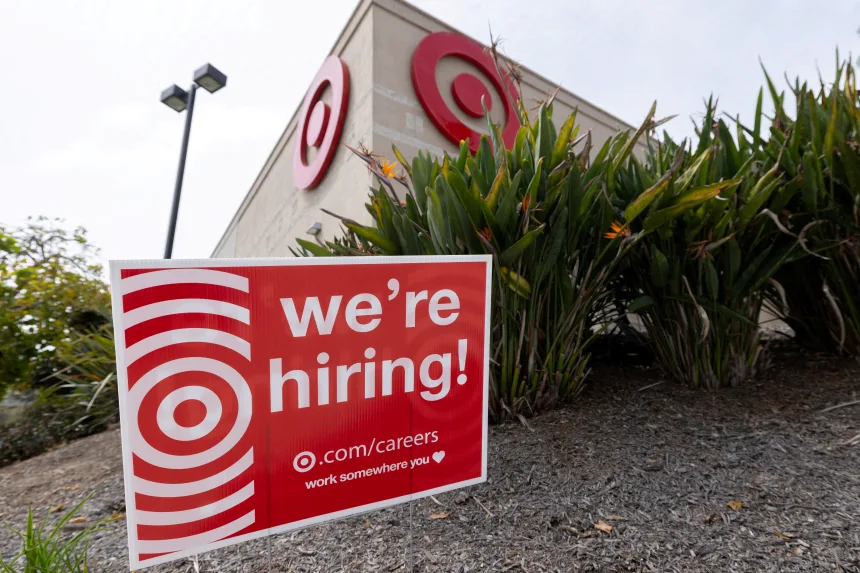 A sign posted outside a Target store states the company is hiring in Encinitas, California, U.S., March 30, 2026. Mike Blake/File/Reuters
“The jobs are more likely to be part-time, they’re more
likely to be in healthcare, they are more likely to be low-paying,” she
said.
Here are a few dynamics to keep in mind and keep an eye out for in Friday’s report:
Healthcare and social assistance – a sector buoyed by an
aging population – has gone from driving job gains to propping up the
entire labor market.
The sector, one of the nation’s largest, accounts for 15% of overall employment.
“My concern for the last two years is how one-note the labor
market was,” Richardson said. “Basically, all the job gains came from
healthcare. Nothing in manufacturing. Construction ebbs and flows with
cyclical interest rates. And no sense of broad-based hiring.”
That appears to be changing, Richardson said.
ADP’s recent monthly employment reports, including one for
May released Wednesday, showed that job gains are picking up across a
wider array of industries in the private sector.
When Friday’s report is released, one metric to watch will
be the Diffusion Index, which provides a measurement of job growth
across major industries. A number greater than 50 indicates that more
industries are adding jobs than shedding them.
Wage gains have been slowing from their post-pandemic highs —
but for the past three years, they were still outpacing inflation.
That changed in April, when the oil supply crunch from the US-Israeli war with Iran (and ensuing price shock) sent inflation to 3.8%. Average hourly earnings that month grew at a rate of 3.6%.
“An uptick in wage growth would be good news for workers
struggling with higher prices, but it would also push the [Federal
Reserve] in the direction of rate hikes,” Dean Baker, senior economist
at the Center for Economic and Policy Research, wrote in a note
Wednesday.
What is the impact of high gas prices, tech layoffs and Spirit’s bankruptcy?
Businesses appear to be treating the spike in fuel prices as
a temporary surge versus a sustained change, ZipRecruiter’s Bachaud
said.
As such, there’s not expected to be a broad or discernible
pullback in hiring or a rise in layoffs, she said, adding that
industries to watch will include transportation, retail and
construction.
 Spirit
Airlines planes sit parked at the Phoenix Goodyear Airport on May 8,
2026 in Arizona. The budget airline ceased all operations on May 2,
2026. Rebecca Noble/Getty Images
Spirit
Airlines planes sit parked at the Phoenix Goodyear Airport on May 8,
2026 in Arizona. The budget airline ceased all operations on May 2,
2026. Rebecca Noble/Getty Images
Employment in the transportation sector is expected to take a
hit in May as a result of the 17,000-employee Spirit Airlines shutting
down its operations on May 2.
Layoff announcements picked up in May, according to a new
report released Thursday morning by Challenger, Gray & Christmas.
The outplacement and coaching firm tracked 97,006 job cuts announced at
US-based firms, up 16% from April and 3% from May of last year.
The lion’s share of the cuts was at technology firms, and
artificial intelligence once again led the reasons for the planned
reductions.
While mass layoffs, especially those cited to AI, make the
headlines, economists aren’t sounding the alarm bells. They note that
claims for unemployment benefits haven’t accelerated dramatically and
remain near historic lows.
AI adoption in the workplace remains “very early days,” Bachaud said.
“We’ve yet to see any widespread job displacement or really widespread growth,” she told CNN.
Rather, AI’s fingerprints are showing up in shifting job
skills and blurring the lines between different roles, she said.
The excitement around AI is moving faster than the reality
of everyday businesses — and also companies’ abilities to keep up,
Bachaud said. Job offers for AI-specific roles, for example, have been
rescinded more for any other job, she said.
“(Businesses) feel like they’re already behind, and there’s
so much pressure to move quickly, but the hiring is still much slower,”
she said.
It can also explain some of the dissonance seen in the
recent labor turnover data where job openings spiked in April while
hiring remained stunted.
“There’s a bit of a mismatch and skill level between what
employers want to hire for and what job seekers are offering.”
That mismatch extends beyond AI, ADP’s Richardson said.
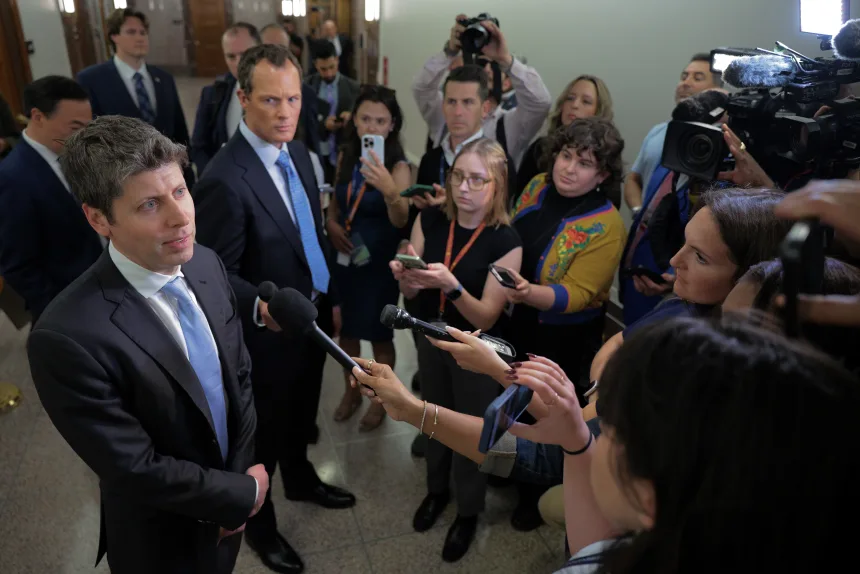 Open AI
CEO Sam Altman speaks with reporters after meeting with Sen. Bernie
Sanders on June 3 in Washington, DC. Altman met with Congressional
leadership the day after President Donald Trump signed an executive
order about artificial intelligence. Chip Somodevilla/Getty Images
Open AI
CEO Sam Altman speaks with reporters after meeting with Sen. Bernie
Sanders on June 3 in Washington, DC. Altman met with Congressional
leadership the day after President Donald Trump signed an executive
order about artificial intelligence. Chip Somodevilla/Getty Images
The
most powerful trend that you’re seeing in the current labor market is
demographics; it’s swamping everything,” Richardson said. “And it’s not
sexy and it’s not making headlines in the same way [as AI].”
For much of the past year, hiring was stifled by high
uncertainty about the effects of policy shifts, tariffs, interest rates
and geopolitical concerns.
What resulted was a stilted pattern of hiring, Richardson said.
“You’ll see strength, and then you’ll see pullback tied to a
headline,” she said. “And that part will last maybe a season, maybe a
couple months, and then you’ll see the hiring restart.”
More Stories From Cnn Business
Uncertainty continues to have an effect on the labor market,
but it’s not outpacing businesses’ desires to hire, said Eugenio
Aleman, chief economist at Raymond James.
“One reason is because there’s less uncertainty about
tariffs; a second reason is that firms have been able to learn from what
happened last year and now they are starting to move ahead with making
employment decisions – especially because the economy continues to
grow,” he said.
This article first appeared on Cnn Business