Link copied
Fed expected to hold rates steady this week as rate hike talks heat up and US strikes a deal with Iran.
watchlist :: 1day ago :: source - yahoo finance
By Jennifer Schonberger
Kevin Warsh will preside over his first interest rate-setting meeting as Federal Reserve chairman on Wednesday, when the central bank is expected to hold rates steady.
All eyes will be on Warsh as Fed watchers try to discern his views, his personal credibility, and how he will position the Fed in the current landscape. The committee is facing hotter inflation readings as the conflict in Iran has pushed inflation higher.
"While Warsh is generally perceived as dovish, he will inherit a committee that has become noticeably more hawkish," said Greg Daco, chief economist at EY-Parthenon.
"Warsh's first challenge will not be steering the committee toward easier policy, but demonstrating that his decisions are grounded in economic fundamentals rather than political considerations."
Inflation has persisted above the Fed's 2% target for more than five years. The latest Consumer Price Index reported headline inflation breaching 4% in May — the highest level in three years — while prices businesses paid soared 6.5%. Core inflation excluding energy prices rose nearly 3%.
Read more: How jobs, inflation, and the Fed are all related
The White House announced a potential breakthrough on Sunday, with the US and Iran agreeing on an interim peace deal that would reopen the Strait of Hormuz this Friday. President Trump has previously indicated that a deal is coming, only for talks to later stall.
The current deal paves the way for a 60-day period of negotiations over Tehran's nuclear program. The agreement to stop fighting and open the Strait, if sustained, could signal a peak in inflation, though energy prices could remain elevated for weeks or months before oil shipments and supply normalize.
Adding to inflationary pressures, the administration is layering on new tariffs to replace old ones struck down by the Supreme Court.
"You've got an inflation problem right now, and you have to communicate that … their resolve around this inflation is their real challenge," said former Kansas City Fed president Esther George.
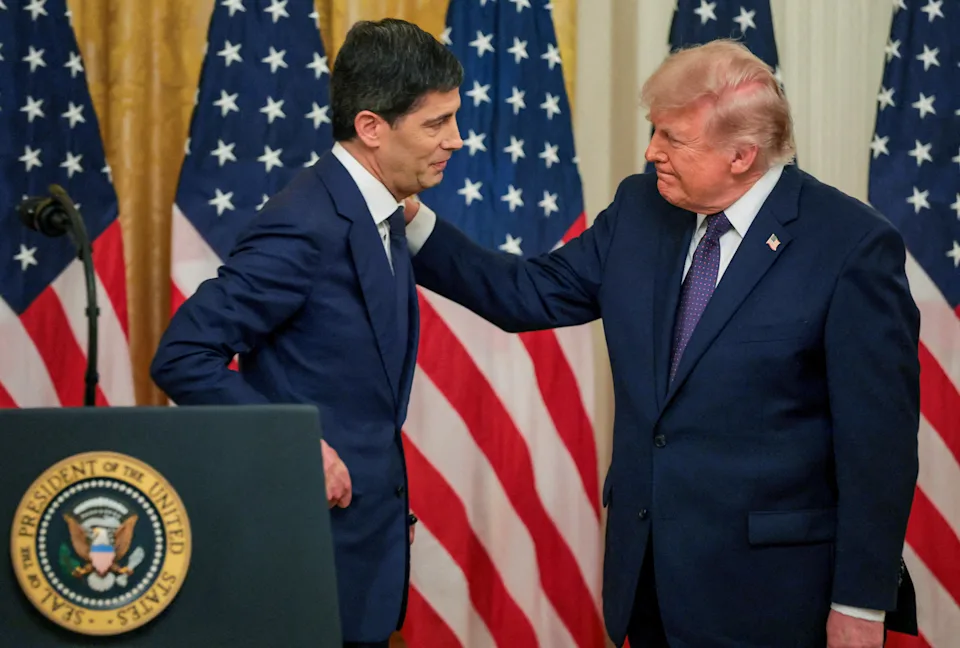 President Donald Trump greets the new Federal Reserve Chair Kevin Warsh
after he was sworn in by U.S. Supreme Court Justice Clarence Thomas, in
the East Room at the White House in Washington, D.C., U.S., May 22,
2026. (REUTERS/Jonathan Ernst/File Photo). REUTERS / REUTERS
President Donald Trump greets the new Federal Reserve Chair Kevin Warsh
after he was sworn in by U.S. Supreme Court Justice Clarence Thomas, in
the East Room at the White House in Washington, D.C., U.S., May 22,
2026. (REUTERS/Jonathan Ernst/File Photo). REUTERS / REUTERS
Warsh unlikely to offer forward guidance as rate hike talks heat up
Fed officials will have the chance to communicate their intentions this meeting through the dot plot — a quarterly exercise where all 19 members of the Fed write down where they think interest rates will be by the end of this year and next year.
Many expect the median will move from one rate cut — set when Fed officials penciled their forecast in March — to holding rates steady this year.
Furthermore, some members have cautioned that rate hikes might be needed if inflation continues to heat up or remains sticky. However, that was before the deal with Iran was announced.
"I think you're going to see a hawkish shift in the dot plot," Patricia Zobel, head of Macroeconomic Research and Market Strategy at Guggenheim Investments, told Yahoo Finance. "You're going to see several participants who have rate hikes as a base case this year, some possibly with two rate hikes this year as a modal case."
Multiple Fed insiders expect the committee to drop language signaling a future rate cut from its statement. It may be replaced by language signaling that cuts or hikes are possible, or the forward-looking statement may be removed altogether.
Stephen Brown, chief economist for North America at Capital Economics, speculated that Warsh won't put forth his own interest rate projection. But he'll still be asked about his views during his press conference.
"The risk for markets is that Warsh will sound more hawkish than expected, either due to a miscommunication or simply because his views are now less dovish than when he was seeking President Trump's nomination," said Brown.
But if Warsh feels beholden to Trump, an overtly dovish tone would reignite concerns about Fed independence and risk pushing up long-end bond yields, Brown warned.
Brown said two "insurance hikes" are now more likely than not in December and early next year.
George said there's a good argument to raise rates. The question will be whether the surge in oil prices or tariffs, both of which the Fed has considered temporary, will be viewed as more persistent. She also noted that the One Big Beautiful Bill and deregulation are juicing the economy and demand.
"I think there'll be a strong desire, maybe even inertia, to say, let's not move until we see whether that's likely. But this is the tale of past inflationary cycles; you want to wait for more information before you move. I hope they will say out loud that they are willing to make an increase in interest rates if this inflation persists."
On the other hand, Luke Tilley, chief economist for Wilmington Trust, projects rate cuts toward the end of 2026 and into 2027. Per Tilley, headline inflation will decelerate but remain at elevated levels into early 2027, while core inflation will slow more substantially. That number will move close to the Fed's target toward the end of the year, Tilley said.
"I think by the time you get through the summer, we'll see that energy prices have not gone through to core inflation, and that inflation is not really a threat," he said. "We think that the Fed will see the direction of travel in inflation and lack of core [inflation] pressure and reduce rates again late this year."
Tilley says the deal that opens the Strait will likely bring down energy prices in the near term. Though it would still take many weeks, or possibly a few months, for activity to return to normal.
"We could be looking at an inflation outlook with most factors pushing to the downside, including: energy declining, tariffs, stagnant home prices, and weak consumer spending," said Tilley. "The only inflationary forces left would be rising metals prices due to tariffs, and the AI impact on computer equipment."
Patrick Harker, former president of the Philadelphia Fed and professor at the Wharton School of the University of Pennsylvania, said even if the war ends, it's going to take time for inflation to come down.
"Even if we get back to what it was before the war, we still had inflation running above 2%," Harker said. "Everybody forgets that we were still not at target … The issues that were creating inflation above 2% before the war are still there."
Jennifer Schonberger is a veteran financial journalist covering markets, the economy, and investing. At Yahoo Finance she covers the Federal Reserve, Congress, the White House, the Treasury, the SEC, the economy, cryptocurrencies, and the intersection of Washington policy with finance. Follow her on X @Jenniferisms and on Instagram.
Click here for the latest economic news and indicators to help inform your investing decisions
This week top market trends.
-
A jobs report, more big chip earnings, and sticky inflation: What to watch this week
2026-06-01 :: stock :: yahoo finance -
Foreign investors buy Japanese stocks for eighth week on AI rally
2026-05-28 :: stock :: reuters -
Medtronic beats quarterly estimates on robust demand for heart devices
2026-06-03 :: companies :: reuters
Recent global market news
-
OpenAI files confidential SEC paperwork for IPO, opening the door to a Wall Street debut
2026-06-09 :: :: apnews