Link copied
TSMC to invest another $100 billion in US as Q2 profit blows past forecasts.
deals & business :: 6hrs ago :: source - reuters
By Wen-Yee Lee, Ben Blanchard and Faith Hung
(Reuters) - TSMC, the world's main producer of advanced AI chips and a major Nvidia supplier, pledged on Thursday to invest a further $100 billion in the U.S. state of Arizona in a win for President Donald Trump, who has pushed for more chipmaking at home.
Reinforcing its bullish viewpoint on AI demand, Taiwan Semiconductor Manufacturing Co <2330.TW> raised its forecast for capital spending by up to 14% for this year.
"Our customers and customers', who are mainly the cloud service providers, continue to provide us with their very strong signal and positive outlook," company CEO C.C. Wei told an earnings conference.
"Thus, our conviction in the multi-year AI megatrend remains very high."
The upbeat outlook came after TSMC, a bellwether for AI chip demand, posted a 77% jump in second-quarter profit to a record high of T$706.6 billion ($22 billion), beating a market forecast of T$632.6 billion and marking its ninth straight quarter of double-digit percentage growth.
Capital expenditure for 2026, a key indicator of management's confidence in the durability of AI demand, is forecast to be between $60 billion and $64 billion, compared with previous guidance of the high end of between $52 billion and $56 billion, it said.
The company also said that its capital spending in the next three years will be "even more significantly higher" than the past three years.
Thriving on surging demand for advanced chips used in AI applications, TSMC's further $100 billion investment in Arizona would add to already-announced investments of $165 billion to build chip factories there.
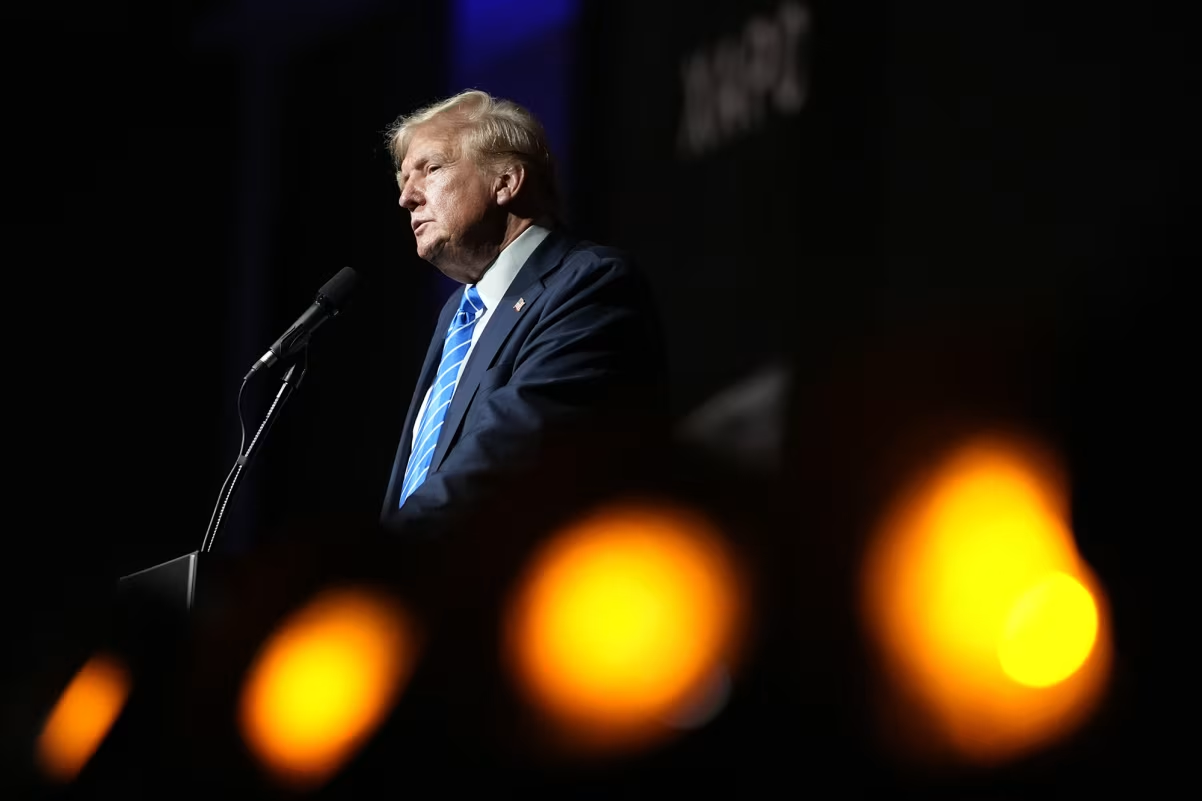
The investment comes amid Trump's repeated accusation that Taiwan is stealing American semiconductor business. He has said that by the time he leaves office, the U.S. will have 50% of the world's semiconductor manufacturing capacity.
"We believe this investment will help to further foster the development of the U.S. semiconductor ecosystem, strengthen the supply chain, and support an increasing number of high-tech, high-paying jobs in the United States," Wei said.
An additional four plants would probably be built in Arizona, including for advanced packaging and adding to the eight already being built or planned, though the timeline for the additional ones would depend on the "market situation", he added.
In a separate announcement on Thursday, the U.S. Commerce Department said TSMC's additional investment "highlights the Trump Administration's commitment to strengthening domestic manufacturing and U.S. technological leadership through strategic partnerships and investment."
The investment will help anchor the agreement on reciprocal trade signed between the U.S. and Taiwan earlier this year, said Nick Marro, principal economist for Asia and lead for global trade at the Economist Intelligence Unit, which cut U.S. tariffs and saw Taiwan pledge to increase investment.
TSMC's aggressive capital spending and soaring profit margins have made it a barometer of demand in the global semiconductor industry.
The company expects full-year revenue in U.S. dollar terms will increase by slightly more than 40% for 2026, compared with a previous forecast of more than 30%. For the current quarter, it forecasts sales between $44.6 billion and $45.8 billion, up from $33.1 billion a year earlier.
Wei said all of TSMC's customers were "very aggressive" in their demand forecasts, but added that simply adding up their projections would overstate actual market demand.
"I believe they try their best to tell me the truth," he said, adding that TSMC also conducts its own analysis of AI data centre construction and broader demand trends before deciding on capacity expansion, to avoid building chips that end up in inventory.
On the AI market, Wei also said the emergence of agentic AI is leading to a resurgence in the role of CPUs in AI data centres, which is driving more silicon demand in addition to AI chip consumption.
Analysts said demand for TSMC's 3-nanometre and 2-nanometre process technologies for AI chips, as well as for its advanced chip packaging technology, CoWoS, remains strong.
That has catapulted Asia's most valuable company, also a key supplier to Apple, to new heights. Its market capitalisation is now nearly double that of South Korean rival Samsung Electronics at around $1.97 trillion.

On Monday, the company announced a 36% rise in second-quarter revenue, ahead of market forecasts and a record high.
In related news, on Wednesday Dutch company ASML, the world's dominant supplier of equipment needed to make high-tech computer chips, raised its 2026 sales forecasts and pledged a capacity boost that may ease fears a production bottleneck could slow the AI boom.
Wei said that TSMC works closely with ASML and whether it adopts the company's next-generation equipment will depend on when it demonstrates sufficient technological capability in manufacturing and cost effectiveness.
TSMC's Taipei-listed shares have gained 59% so far this year, largely in line with the broader market.
($1 = 32.1340 Taiwan dollars)
(Reporting by Wen-Yee Lee, Ben Blanchard and Faith Hung; Editing by Christian Schmollinger)
This week on Reuters
This week top market trends.
-
America’s inflation problems aren’t going away anytime soon
2026-07-14 :: opinion & analysis :: cnn business -
Oil prices rise 1% as hostilities worsen in the Middle East
2026-07-15 :: commodities :: reuters -
$3.2 trillion rotation from chips to the 'Magnificent 7' has left the S&P 500 going nowhere
2026-07-16 :: stock :: yahoo finance
Recent global market news
-
OpenAI's First Device Will Be Movable, Screenless Speaker Built as AI Companion
1day ago :: :: bloomberg -

Meta says US states are seeking $1.4 trillion in penalties in August youth safety trial
2026-07-07 :: :: reuters -
Meet the Ultra-Low-Cost Vanguard ETF That Has 53% of Its Holdings in Tech Giants Like the 'Magnificent Seven' Stocks
2026-07-12 :: :: motley fool