Link copied
One day after doubling Treasury buybacks, Bessent says he's ready to boost them further to push down long-term yields.
treasuries & bonds :: 7hrs ago :: source - yahoo finance
By Jennifer Schonberger
Treasury Secretary Scott Bessent signaled that he is willing to expand the Treasury Department's buyback program as long-term bond yields rebounded on Thursday, one day after he announced a doubling of purchases this fall.
Bessent told CNBC that the Treasury's buyback program of government debt could surpass the $4 billion announced on Wednesday.
"We are going to make a market in these. We routinely do buybacks, and we're going to increase the size of the buyback … it could be more than $4 billion per issue," Bessent said.
He noted that the Treasury is trying to signal support during a typically thin August trading session — particularly for the 30-year Treasury — at a time when massive corporate bond issuance is distorting the market, along with other factors.
"We have a big toolkit," Bessent added. "Part of it is signaling here to show that we believe yields don't reflect the underlying fundamentals of this Iran conflict. We will get on the other side of this."
The US Treasury announced actions on Wednesday to lower long-term government bond yields, saying it would "at least double" the amount of 10-year, 20-year, and 30-year Treasury bonds it buys back from $2 billion to $4 billion. The operation will begin on Sept. 9 and remain effective through Nov. 4.
However, the announcement's impact proved short-lived. Long-term yields reversed course on Thursday morning, with the 10-year Treasury climbing above 4.7%, up from Wednesday's low of roughly 4.64%.
Read more: How soaring Treasury yields could impact your finances
The notion of even bigger buybacks was widely met with skepticism.
"A moderately bigger buyback program amounts to a weak form Operation Twist … that in itself will have little enduring impact and could backfire if it is seen as signaling concern about the ability to fund longer-term at acceptable cost," Evercore ISI head of central banking strategy Krishna Guha said.
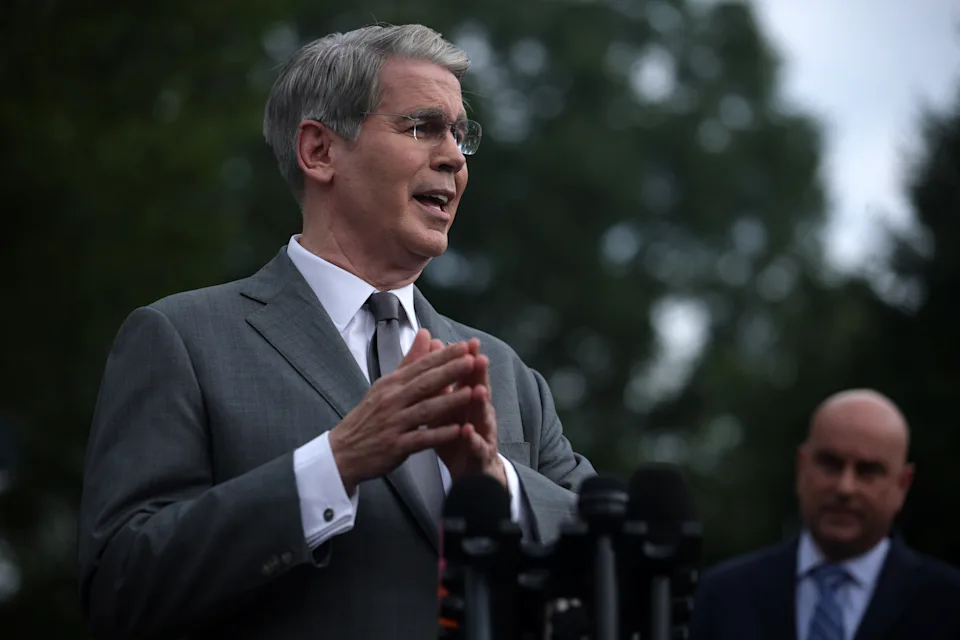 Treasury Secretary Scott Bessent speaks to members of the press outside
the West Wing at the White House on Aug. 20, 2026, in Washington, D.C.
(Alex Wong/Getty Images)
Treasury Secretary Scott Bessent speaks to members of the press outside
the West Wing at the White House on Aug. 20, 2026, in Washington, D.C.
(Alex Wong/Getty Images)
Wall Street experts remain doubtful that the Treasury can artificially suppress interest rates for long. They have also questioned how much gunpowder the Treasury secretary is willing to deploy to counteract higher interest rates as the fundamental forces pushing yields higher remain intact.
A confluence of macroeconomic pressures is driving the rise: a widening fiscal deficit, inflation running above the Federal Reserve's 2% target, a weaker dollar, and an avalanche of corporate bond issuance by tech companies to fund artificial intelligence and data center expansions.
The market pressures come as the total US national debt surpassed $40 trillion this week, after adding $1 trillion in new debt to government balance sheets in just a few months. The national debt has now more than doubled in less than a decade during the presidencies of Donald Trump and Joe Biden. It has quadrupled in less than 20 years.
Read more: How the soaring federal debt affects you personally
Addressing the debt expansion, Bessent said the administration will announce an "increased focus on fiscal consolidation" late this week or early next week. "It's coming from President Trump," Bessent said. "[OMB Director] Russ Vought and myself will be examining both the revenue side and the cost side to see what we can do."
When asked about the $40 trillion figure and how to reverse it, Bessent noted that while it is a "big number," the amount is smaller when looking strictly at publicly traded debt.
"We're going to have to grow our way out of this," he said, adding that "there's a good chance" the US has already seen peak deficits.
Bessent argued that refunds from tariffs have been driving up the deficit, pushing it higher, but that the administration is looking to recoup that tariff revenue. He pointed to US Trade Representative Jameison Greer, who is conducting studies to propose new tariffs, and said he expects tariff income this year will be the same as last year.

Treasury's actions to lower long-term government bond yields may complicate Federal Reserve Chairman Kevin Warsh's job — and may even force him to act more aggressively to raise interest rates.
When asked whether Treasury's actions make the Fed's job harder, St. Louis Fed president Alberto Musalem told CBNC Thursday, "No, we focus very simply on the labor market and on inflation. We independently set monetary policy, independent of debt management or fiscal policy."
Jennifer Schonberger is a veteran financial journalist covering markets, the economy, and investing. At Yahoo Finance, she covers the Federal Reserve, Congress, the White House, the Treasury, the SEC, the economy, cryptocurrencies, and the intersection of Washington policy with finance. Follow her on X @Jenniferisms and on Instagram.
Click here for the latest economic news and indicators to help inform your investing decisions
This week top market trends.
-
Key checks from Walmart and the big box stores: What to watch this week
2026-08-17 :: watchlist :: Yahoo finance -
Walmart raises guidance, but the stock drops on slower sales growth
2026-08-20 :: companies :: yahoo finance -
Walmart promises price cuts after $2.9 billion tariff refund
2026-08-21 :: companies :: cnn business

Recent global market news
-

Warren Buffett’s Berkshire Is Buying These 2 Homebuilding Stocks. Housing Market Recovery Coming?
1day ago :: :: insider monkey -
This stock market indicator just flashed a warning not seen since the dot-com bubble
2026-08-11 :: :: yahoo finance