Link copied
The Weakening US Dollar in 2026: What It Really Means for Bitcoin and Your Crypto Portfolio.
crypto :: 2026-08-24 :: source - investorshd
By Ijlal Ahmed | InvestorsHD
 The Weakening US Dollar in 2026: What It Really Means for Bitcoin and Your Crypto Portfolio
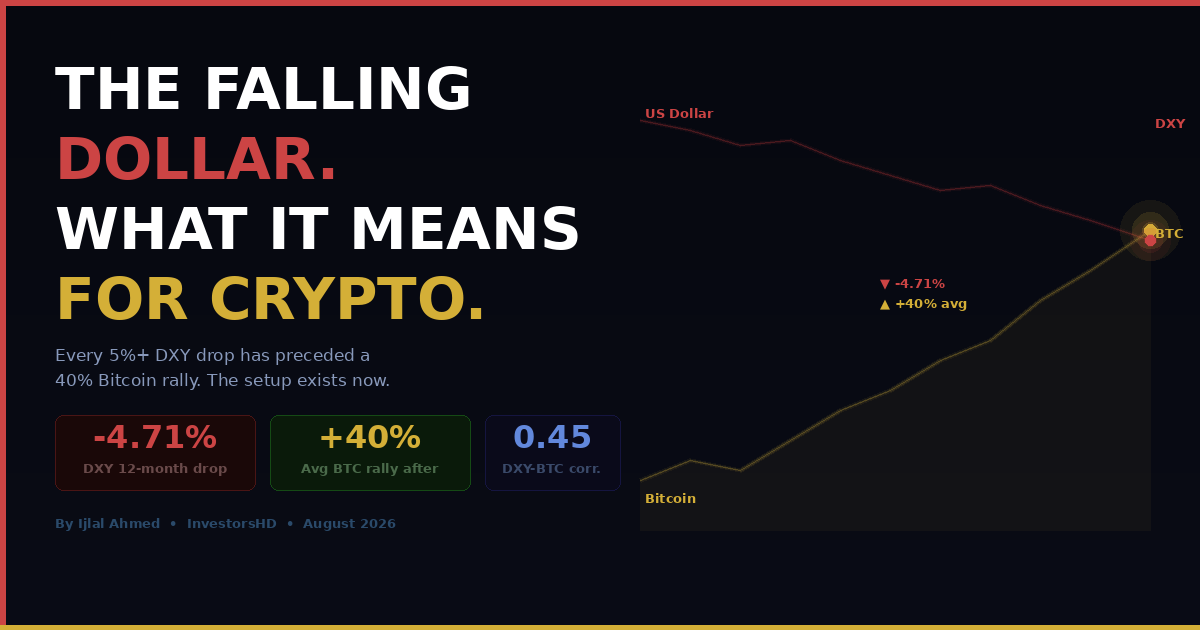
The US Dollar Index — known as the DXY, a measure of the dollar's value against a basket of six major global currencies — is down 4.71% over the past twelve months. That might sound like a dry financial statistic. It is not. It is one of the most important macro signals in the entire global financial system right now, and its implications for Bitcoin and crypto are profound, nuanced, and widely misunderstood.
The popular version of the dollar-crypto relationship goes like this: dollar weak, Bitcoin up. Dollar strong, Bitcoin down. Simple, clean, reliable. And for most of the period between 2014 and 2023, that relationship held with enough consistency that traders built strategies around it. The correlation coefficient between the DXY and Bitcoin was a strong 0.7 between 2014 and 2020. But 2026 is telling a more complicated and more interesting story. That correlation has weakened to just 0.45, according to research from VanEck. The relationship is not broken — but it has changed. Understanding how and why is the difference between making informed decisions with your portfolio and acting on a model that no longer accurately describes the market you are actually in.
What Is Actually Happening to the Dollar in 2026
The DXY spent much of early 2026 holding above 100 — a psychologically significant level that traditionally signals dollar strength. But the picture has shifted. As of August 2026, according to KuCoin's Bitcoin and US Dollar analysis published August 2026, on August 17, softer US economic data reduced expectations for another near-term Federal Reserve rate increase, weakening the dollar. Two days later, the reaction became much stronger after the US Treasury announced larger long-duration bond buybacks — sending Treasury yields lower, pushing DXY toward a three-month low, and lifting Bitcoin alongside equities and gold simultaneously.

The structural forces weakening the dollar in 2026 are not temporary. According to Phemex's March 2026 analysis of DXY and Bitcoin historical patterns, the DXY is down 4.71% over the past twelve months despite the US running massive fiscal deficits and a military conflict that would traditionally strengthen the dollar through safe-haven flows. That divergence is the signal. The dollar is weakening even in an environment where it should be strengthening. The forces at work include: a ballooning national debt that the market is increasingly pricing as a structural rather than cyclical problem; tariff uncertainty reducing global trade efficiency; and growing international reserve diversification as countries quietly shift away from dollar-denominated assets.
The DXY reversed sharply from above 100 to around 99.12 on March 23, 2026, after President Trump announced productive conversations with Iran about ending the four-week-old military conflict, sending Brent crude down more than 7% in a single session. The 10-year Treasury yield eased to 4.35% by March 25, pulling back from eight-month highs. Bitcoin climbed to $71,674 on the same day, recovering 5% from a dip below $68,000. The chain of causation — ceasefire signal, oil drop, inflation expectations ease, dollar weakens, Bitcoin rises — played out in real time and in exactly the sequence that the macro model predicts.
The Historical Pattern — What Dollar Weakness Has Always Done to Bitcoin
The historical record of DXY movements and Bitcoin prices is remarkably consistent over the past decade. According to BeInCrypto's May 2026 DXY analysis, Bitcoin's major expansion phases in 2013, 2017, and 2020 all lined up with DXY weakness below 90. Conversely, DXY rallies in 2014, 2018, and 2022 coincided with deep Bitcoin drawdowns of 60% or more.
The mechanism is straightforward. When the dollar strengthens, global investors — who price risk assets in dollars — find that their returns in local currency terms are being eaten by currency appreciation. A Brazilian investor holding Bitcoin who sees the dollar rise 10% against the real effectively loses 10% in local purchasing power even if Bitcoin's dollar price stays flat. This creates selling pressure across all dollar-denominated risk assets. Conversely, when the dollar weakens, the reverse dynamic applies: every dollar-priced asset becomes more attractive to international holders, and the capital that was sitting in cash seeking safety from a strong dollar rotates back into risk. According to Phemex's analysis of historical DXY-BTC correlations, every major DXY decline of 5% or more has preceded a Bitcoin rally averaging 40% over the following six months.
Why the 2026 Relationship Is More Complex — The Institutional Factor
Here is where 2026 diverges from the simple historical model — and why investors who rely purely on the DXY as a Bitcoin signal are working with an incomplete picture. According to OSL's DXY vs Bitcoin correlation analysis, the correlation coefficient between DXY and Bitcoin that was a strong 0.7 between 2014 and 2020 has weakened to just 0.45 in the current cycle. VanEck's research confirms this structural moderation. The reason is institutional demand.
Spot Bitcoin ETF flows reached $1.97 billion in April 2026 — the strongest single month of 2026. BlackRock, Fidelity, and other major issuers have created a steady institutional bid for Bitcoin that operates on multi-year investment thesis timelines, not on daily DXY fluctuations. According to BeInCrypto's analysis of institutional Bitcoin demand, that sensitivity to dollar movements appears to be fading as flows from BlackRock and other issuers anchor a steady bid. When BlackRock is buying Bitcoin on a pre-committed institutional schedule, a 1% move in the DXY does not trigger a liquidation.
NYDIG reported that Bitcoin declined 13.4% during Q2 2026 even as technology stocks rallied — reinforcing the point that BTC is increasingly being driven by crypto-specific demand conditions rather than macro sentiment alone. This is a genuinely new dynamic. As KuCoin's August 2026 analysis put it: 'Bitcoin increasingly trades at the intersection of traditional macroeconomics and crypto-specific market forces, meaning institutional demand, ETF flows, leverage and investor positioning can sometimes matter more than movements in the dollar itself.'
The Three Scenarios for the Dollar — and What Each Means for Crypto
Based on the current macro environment, there are three plausible trajectories for the US dollar over the next twelve months — and each has meaningfully different implications for crypto investors.
Scenario 1: Continued gradual weakening (most likely). The structural forces — fiscal deficits, tariff uncertainty, Iran war aftermath, reserve diversification — continue to weigh on the dollar while the Fed under Kevin Warsh cuts rates cautiously in H2 2026. The DXY drifts toward 96-97. In this scenario, the historical 40% Bitcoin rally following a 5% DXY decline would be the base case, but modulated by institutional demand dynamics. This is the most favorable scenario for crypto in the near term.
Scenario 2: Dollar re-strengthening (possible if inflation resurges). If the Iran ceasefire collapses, oil prices spike again, inflation re-accelerates, and the Fed is forced to hold or hike rates, the DXY could reclaim 100-102. This would create headwinds for Bitcoin specifically — though institutional ETF flows may provide a floor that did not exist in previous dollar-strength cycles.
Scenario 3: Sharp dollar decline (least likely but highest crypto impact). A coordinated G7 intervention to weaken the dollar — something that has been discussed but not implemented — or a sovereign debt crisis that forces rapid Fed balance sheet expansion would be the most bullish possible macro scenario for Bitcoin. In this scenario, Bitcoin's role as a fixed-supply asset outside the fiat system becomes the dominant investment thesis, and the DXY-BTC relationship would likely revert toward its historical strength. Bernstein's $150,000 Bitcoin target assumes something close to this scenario playing out in H2 2026.
What the Dollar's Decline Means Beyond Bitcoin — The Broader Crypto Impact
The dollar's structural weakening in 2026 is not just a Bitcoin story. It is reshaping the entire crypto market in ways that matter for every investor in the space.
Stablecoins and dollar hegemony. The paradox of 2026's dollar weakness is that it is happening simultaneously with stablecoins — dollar-pegged tokens — reaching a record $313 billion market cap. Every USDT and USDC holder outside the United States is effectively choosing to hold dollar exposure voluntarily. Stablecoin growth is simultaneously a sign of dollar demand globally and a risk to traditional banking systems, as dollar-denominated digital assets bypass the correspondent banking system entirely.
Emerging market crypto adoption accelerates. Countries whose currencies are losing value relative to even a weakening dollar — Argentina, Turkey, Nigeria, Pakistan — are seeing crypto adoption accelerate as citizens use Bitcoin and stablecoins as a hedge against local currency collapse. South America saw crypto adoption grow 116.5% since 2023, driven by Argentina and Brazil's currency crises. Dollar weakness is a relative concept: a dollar down 5% against major currencies is still dramatically stronger than the Argentine peso or Turkish lira over the same period.
Tokenized US Treasuries benefit from dollar uncertainty. The $12.88 billion tokenized US Treasury market represents institutional investors who want dollar yield without dollar-system exposure. When the dollar weakens, tokenized real-world assets that produce yield become more attractive relative to holding dollar cash. This is one of the structural drivers of the explosive growth in the RWA tokenization sector through 2026.
What Investors Should Actually Do Right Now
Watch the DXY but do not use it alone. The DXY remains a useful macro compass — a falling DXY is more favorable for crypto than a rising one. But in 2026, with institutional ETF flows now providing a floor under Bitcoin, the DXY's predictive power for short-term price movements has reduced. Use it as one input among several, not as a standalone signal.
Monitor the September Fed meeting closely. Any dovish signal from Fed Chair Kevin Warsh — a rate cut, softer language about future hikes, or a slowing of balance sheet reduction — would simultaneously weaken the dollar and improve risk appetite. This is the single most important macro calendar event for crypto in the near term.
Understand what you are actually hedging. Bitcoin as a dollar-debasement hedge works over multi-year periods, not in single trading sessions. If you are buying Bitcoin because you believe the dollar will be worth less in five years, the DXY moving from 99 to 101 in any given week is noise, not signal. If you are trading around DXY movements, that is a different strategy with different time horizons and different risk profiles.
Stablecoins as a dollar bridge. For investors outside the United States who want dollar exposure without traditional banking access, USDC and USDT provide dollar-denominated holdings that benefit from the dollar's global reserve status while bypassing the banking system. In a weakening dollar environment, this is a temporary shelter rather than a long-term store of value — but as a tactical position, it serves a clear function.
The Bottom Line
The US dollar is structurally weakening in 2026 — not collapsing, not in crisis, but declining in a way that is driven by forces that do not resolve quickly: fiscal deficits, geopolitical realignment, tariff uncertainty, and growing reserve diversification. The historical relationship between dollar weakness and Bitcoin strength is real, well-documented, and operating in this cycle. But 2026 has introduced a new variable — institutional ETF demand — that modulates the relationship and provides a floor under Bitcoin that did not exist in previous dollar-strength cycles.

Every major DXY decline of 5% or more has historically preceded a Bitcoin rally averaging 40% over the following six months. The DXY is already down 4.71% over the past year. The setup exists. What remains to be determined is the timing and the catalyst — whether it is a Fed rate cut in September, a durable Iran peace settlement that collapses oil prices, or the continued structural shift of global capital away from dollar-denominated assets toward scarce alternatives. In any of those scenarios, the fixed-supply, borderless, 24-hour asset that never closes is positioned to benefit. The question for investors is not whether dollar weakness is good for crypto. The historical record is clear that it is. The question is how much of that move you will be in when it happens.
Sources
1. Bitcoin and the US Dollar: How DXY, Liquidity and Fed Policy Really Affect BTC — KuCoin, August 2026.
2. Dollar Weakness and Bitcoin: How DXY Drops Have Fueled BTC Rallies — Phemex, March 2026.
3. DXY vs Bitcoin: 2026 Correlation Shift Explained — OSL, 2026.
4. US Dollar Index Hits 4-Month Low: What This Could Mean for Bitcoin — Yahoo Finance, January 2026.
5. US Dollar Is Becoming Strong Again, Will It Impact Bitcoin? — BeInCrypto, May 2026.
6. How Does the US Dollar Index DXY Impact Bitcoin Prices in 2026? — BitcoinWorld / MEXC.
7. Bitcoin Falls 25-31% in 2026 as US Dollar Stays Firm — Pluang, August 2026.
Risk Disclaimer
This article is for informational and educational purposes only and does not constitute financial, investment, or trading advice. All data, statistics, and market information referenced in this article are sourced from publicly available reporting as of August 2026. Cryptocurrency markets and currency markets are highly volatile and speculative. Past correlations between the DXY and Bitcoin do not guarantee future price movements. Always conduct your own research and consult a qualified financial advisor before making any investment decisions. The author and InvestorsHD are not responsible for any financial losses based on information in this article.
This week top market trends.
- no recent market datas