Link copied
Coming Wednesday: The 'Super Bowl of jobs reports'
watchlist :: 12hrs ago :: source - yahoo finance
By Emma Ockerman
The Labor Department will publish much-anticipated jobs data for January on Wednesday, as well as sweeping revisions to 2025 numbers that could show far fewer new positions were added to the US economy than previously thought.
Private data released last week indicated the labor market remained bruising in January for out-of-work Americans, with little in the way of new jobs. Economists surveyed by Bloomberg estimate a median gain of about 68,000 jobs in January’s report, though the projections varied widely: The highest saw 135,000 more jobs, while the lowest saw a loss of 10,000 roles. The unemployment rate was expected to remain steady at 4.4% when the report is released at 8:30 a.m. ET.
As for 2025, preliminary data for the 12 months ending in March last year showed 911,000 fewer jobs being created than initially reported. Numbers for that period will be updated Wednesday, in addition to data changes for more recent months, likely leaving a dimmer picture of the 2025 job market.
The government’s monthly employment situation report, which includes both the unemployment rate and payroll growth, was meant to be published last Friday before it was delayed by the brief partial government shutdown. That left market-watchers and economists waiting a few extra days for what Bank of America Global Research dubbed the “Super Bowl of jobs reports” and economist Michael Madowitz of the Roosevelt Institute called #ConspiracyTheoryJobsday.
The data revisions are a standard part of the Labor Department’s endeavors to show its work. Preliminary payroll data is always revised twice in the two months after it’s first published. Then there are the so-called benchmark revisions.
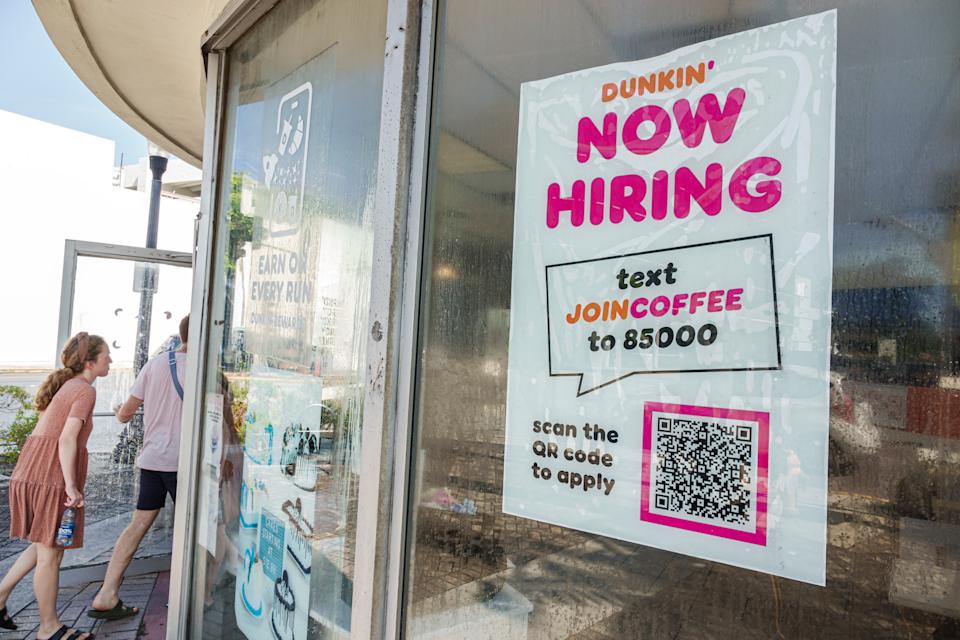 A hiring sign at a Dunkin' Donuts in Miami Beach, Fla. (Jeffrey Greenberg/Universal Images Group via Getty Images)
“Revisions to data are a sign of accuracy, not inaccuracy or conspiracy,” Madowitz wrote in a post on the Roosevelt Institute’s website. “It’s difficult to cook the books when you publish very detailed recipes.”
Still, the revisions, which account for state unemployment insurance tax records for the period from April 2024 through March 2025 and will also include changes to more recent monthly payroll growth, could trigger reactions from both the market and the Trump administration.
The White House was attempting to soften expectations days ahead of the release, with National Economic Council Director Kevin Hassett saying smaller job gains may also be explained by a “productivity boom.”
But less rosy revisions have been forecast for a while now. Federal Reserve Chair Jerome Powell said in December that the country may have shed 20,000 jobs on average each month since April, rather than gaining an average of 40,000. (The most recent jobs report already showed that 2025 was the worst year for hiring since 2020.)
Still, Powell saw the labor market as “gradually cooling” rather than collapsing, noting that growth in worker supply was also soft. Officials from the Trump administration have also said this week that amid lower immigration levels, smaller payroll growth is necessary.
Federal Reserve Governor Christopher Waller, meanwhile, said last month that “this does not remotely look like a healthy labor market.”
“Last year's data will be revised downward soon to likely show that there was virtually no growth in payroll employment in 2025. Zero. Zip. Nada,” Waller said. “Let this sink in for a moment — zero job growth versus an average of almost 2 million for the 10 years prior to 2025.”
Emma Ockerman is a reporter covering the economy and labor for Yahoo Finance. You can reach her at emma.ockerman@yahooinc.com.
This week top market trends.
-
Yen extends gains after Takaichi election victory, US data in focus
2026-02-10 :: foreign exchange :: reuters -
Amazon cuts 16,000 jobs globally to undo pandemic-era hiring amid AI push
2026-01-28 :: companies :: reuters -
Spotify forecasts profit above estimates as founder Daniel Ek moves to new role
2026-02-10 :: companies :: reuters -
Yen tumbles on election bets, dollar still under pressure
2026-01-13 :: foreign exchange :: reuters -
S&P 500 Profit Beats Draw Worst Stock Price Reaction on Record
2026-01-21 :: stock :: bloomberg
Recent global market news
-

Alphabet set to report Q4 earnings in test of stock's rally amid Google's AI wins
2026-02-04 :: :: yahoo finance -

Yen volatile as rate check speculation swirls, dollar set for steep weekly drop
2026-01-23 :: :: reuters