Link copied
Down 76% from high, Nike stock offers dividend yield of about 4%.
trade ideas :: 8hrs ago :: source - thestreet
By Aditya Raghunath
Nike stock has lost roughly 76% from its all-time high in late 2021. Shares are sitting around $43 in April 2026, close to their lowest levels since 2014.
The sell-off has been brutal.
But here's the thing: The deeper a stock falls, the higher its dividend yield climbs, assuming the payout stays intact.
And for income-focused investors, that math has created a rare opportunity in one of the most recognized brands on the planet.
“Dividend-paying stocks provide a way for investors to get paid during rocky market periods, when capital gains are hard to achieve," according to Fidelity. "They may provide some hedge against inflation, especially when they grow over time.”
That's exactly the case Nike (NKE) finds itself in: a company paying shareholders to wait while management works to right the ship.
The question is whether the wait is worth it.
Nike's dividend stock case: the numbers
Nike has been paying dividends for almost four decades. That's multiple years of uninterrupted quarterly payouts — through recessions, pandemics, and multiple market downturns.
Nike has raised its annualized dividend from $0.64 in 2016 to $1.64 in 2026.
Over the next 12 months, the footwear giant will pay $2.4 billion in dividends, while its free cash flow is forecast at $1.98 billion in fiscal 2026 (ending in May).
Nike has a payout ratio over 100%, which is unsustainable. However, analysts forecast FCF to improve to $2.85 billion in fiscal 2027 and $3.91 billion in fiscal 2030.
Key dividend metrics for NKE stock right now:
Annual dividend per share: $1.64
Quarterly dividend per share: $0.41
Forward dividend yield: About 3.8% (as of early April 2026)
5-year historical average yield: About 1.5%
Dividend growth (past 12 months): 5%
Payout ratio: Over 100%
Consecutive years paying dividends: 30+
The yield, at nearly four times its five-year average, tells you just how far the stock has fallen. But that elevated payout ratio is worth watching.
At over 100%, Nike is paying out everything it earns (and more) in dividends, leaving little margin for error if earnings slip further.
What Nike's earnings showed
Nike posted fiscal Q3 results that were better than feared, but the guidance rattled investors.
Earnings came in at $0.35 per share, beating the $0.28 Wall Street expected.
Revenue was essentially flat year over year at $11.28 billion, slightly ahead of estimates.
On the surface, that sounds decent. But dig deeper, and the picture gets complicated.
Net income fell 35% compared to the same period a year ago.
Gross margins dropped by 1.3 percentage points to 40.2%, largely due to higher tariffs in North America.
Nike's digital business declined 9%. Its stores fell 5%. Only wholesale grew by 1%.
CFO Matt Friend flagged that Nike's gross profit margin took a roughly 3% hit from new U.S. tariffs alone.
Related: Nike’s latest quarter shows customers have changed
He also warned that the broader environment is increasingly unpredictable, noting that rising oil prices, Middle East disruptions, and other macro factors could all weigh on consumer behavior in the months ahead.
For Q4, Nike guided for revenue to fall 2-4%, with Greater China expected to drop roughly 20%.
Wall Street loses patience with this dividend stock
The market's reaction was swift, given NKE stock is down almost 25% in the past month. And Wall Street banks moved to the sidelines.
JPMorgan analyst Matthew Boss cut his rating from “overweight” to “neutral.” He slashed his December 2026 price target to $52 from $86.
Boss lowered his fiscal 2027 earnings per share estimate to $1.63, a figure 28% below consensus.
He also pushed back Nike's timeline to reach a 10% operating margin to fiscal 2029, a year later than he had anticipated.
Source: Investing.com
"Our timeline for NKE to return to a 10% operating margin now extends to FY29," Boss wrote, projecting earnings power of around $2.70 per share at that margin level, Investing.com reported.
The report also stated that Bank of America's Lorraine Hutchinson moved NKE stock to “neutral,” cutting her price target to $55 from $73.
She trimmed her fiscal 2027 and 2028 EPS estimates to $1.60 and $2.00, respectively.
Both analysts flagged weakness in Greater China and softness in Sportswear as persistent concerns.
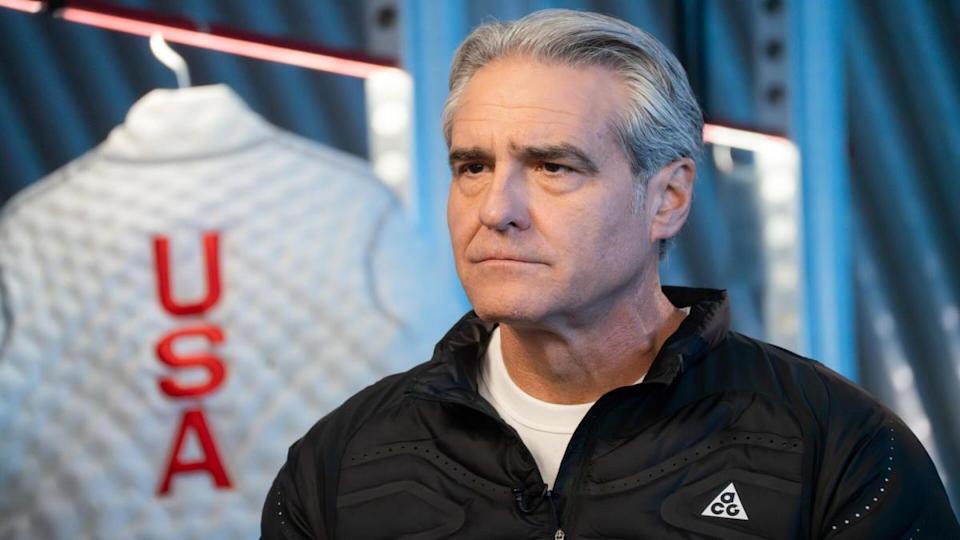 Nike CEO Elliott Hill shared that the company's comeback will take time.Getty Images/ Bloomberg · Getty Images/ Bloomberg
Nike’s delayed comeback plan
CEO Elliott Hill, who returned to Nike in late 2024 to lead the turnaround, has been candid that the rebuild is a multi-year project.
In fiscal Q3, Nike intentionally pulled back roughly $4 billion in classic footwear inventory from the marketplace.
The move created about a five-point drag on reported revenue — painful in the near term, but designed to clean up overstuffed shelves and protect brand equity long term.
The good news is that Nike Running was up over 20% for the quarter, and momentum is building in global football ahead of the 2026 World Cup.
More on dividend stocks:
$1,000 of AVGO stock from 2016 is worth this much with dividends
Early Apple stock investors now earn a 5.2 percent dividend yield
How much to invest in AT&T stock for $1,000 in 2026 annual dividends
Wholesale in North America grew 11%. New innovation platforms, including the Nike Mind headgear (which sold out in all geographies) and a new Liquid Air Max, suggest the product engine is firing.
The bad news: Sportswear, which still makes up a large chunk of the business, declined by low double digits. Greater China fell 10%. The digital business remains overly promotional, and sell-through trends are below plan in several geographies.
Hill drew a vivid parallel in his prepared remarks, comparing Nike to FC Barcelona as it rebuilds Camp Nou while still competing in La Liga.
"We are removing what is not working," he said. "We are rebuilding parts of the foundation that needed to be rebuilt. And at the same time, we are continuing to innovate, to compete and to create for the future."
Nike expects to wrap up its Win Now restructuring actions by the end of 2026. An Investor Day is planned for the fall at its Beaverton, Ore., campus, where management says it will lay out a longer-term financial roadmap.
Related: The Dow’s best dividend stocks: A shortlist for income investors
Is the Nike dividend safe?
That's the real question for anyone eyeing NKE as a dividend stock.
The payout ratio above 100% is a red flag. If margins remain suppressed through fiscal 2027, as both JPMorgan and Bank of America now expect, the dividend could appear stretched relative to profits.
For patient investors, Nike at these levels is essentially a bet that the brand will survive its stumble and earn its way back to growth.
If that happens, those buying near $44 with about a 4% yield will have locked in an attractive income stream at a generational low.
If not — and the turnaround drags into fiscal 2029 as analysts now fear — the dividend may eventually come under pressure.
The stock is not without risk. But for long-term income investors, the setup is hard to ignore.
Related: Nike stock price gets reset by Barclays
This story was originally published by TheStreet.
Add TheStreet as a Preferred Source by clicking here.
This week top market trends.
-
Global equity funds see highest outflows since December on oil shock fears
2026-03-13 :: stock :: reuters -
Stagflation Trades Sweep Markets as Trump Signals Widening War
2026-03-09 :: stock :: bloomberg -
Worries about global economic pain deepen as the war in Iran drags on
2026-03-30 :: general :: apnews

Recent global market news
-
Oil prices crater after Trump announces two-week ceasefire in US-Iran war
1day ago :: :: yahoo finance