Link copied
SpaceX stock now enters the post-honeymoon faith phase.
stock :: 2hrs ago :: source - yahoo finance
By Julie Hyman
A flood of analyst initiations on SpaceX (SPCX) hit the market Tuesday, 16 trading days after Elon Musk's rocket-telecom-AI-neocloud-social media company made its debut.
Most of them were bullish.
The stock fell by nearly 7%, closing below $150 for the first time since the SpaceX IPO.
I've long called investing in Musk's endeavors faith-based. With SpaceX's IPO, shareholders are called upon to believe as never before. Including today's notes, analysts' average price target for the stock as tracked by Bloomberg is $236.45, 58% above Tuesday's close.
Consider a partial list of milestones and hurdles that SpaceX must reach to rally that much and more in the coming years, according to their research notes:
Achieve Starship reusability. SpaceX's model pivots on its ability to launch and reuse rockets, making its ecosystem cost-effective.
Increase Starship payloads. Closely tied to the reusability goal, Starship must be able to carry enough weight on its missions to maximize efficiency.
Make Grok competitive following the closure of the Cursor acquisition.
Successfully and cost-effectively develop solar-powered data centers in space.
Raise $84 billion annually from 2027-2034 to support this build-out, according to Morgan Stanley's Adam Jonas. (Goldman Sachs' Eric Sheridan frames it as $270 billion of debt capital to be raised between 2026 and 2030).
"To make life multi-planetary, leverage the Sun to build out AI in space, & build bases on the Moon and cities on other planets," as JPMorgan's Doug Anmuth writes. No biggie.
The uncertainty of these goals is reflected in the wide range of forecasts related to them. For example, JPMorgan (JPM) projects 5,000 Starship launches by 2031; RBC expects 2,440 by 2030.
Elon Musk brings out the preacher and the poet in even the most spreadsheet-minded number cruncher on Wall Street:
"SpaceX's ambitions — and potential impact on humanity — are bigger than any company's we've ever seen." (Doug Anmuth, JPMorgan)
"Musk has established himself as one of this generation's greatest innovators, and SpaceX has carried the torch for the U.S. industrial base during a time when peers have struggled." (Louie DiPalma, William Blair)

"SpaceX represents in our view the apex of civilizational ambition, oftentimes expressed in steel and fire, bending the arc of history to make humans multiplanetary by building foundational infrastructure across transportation, connectivity, and AI." (Edison Yu, Deutsche Bank, who should consider moonlighting as a sci-fi author).
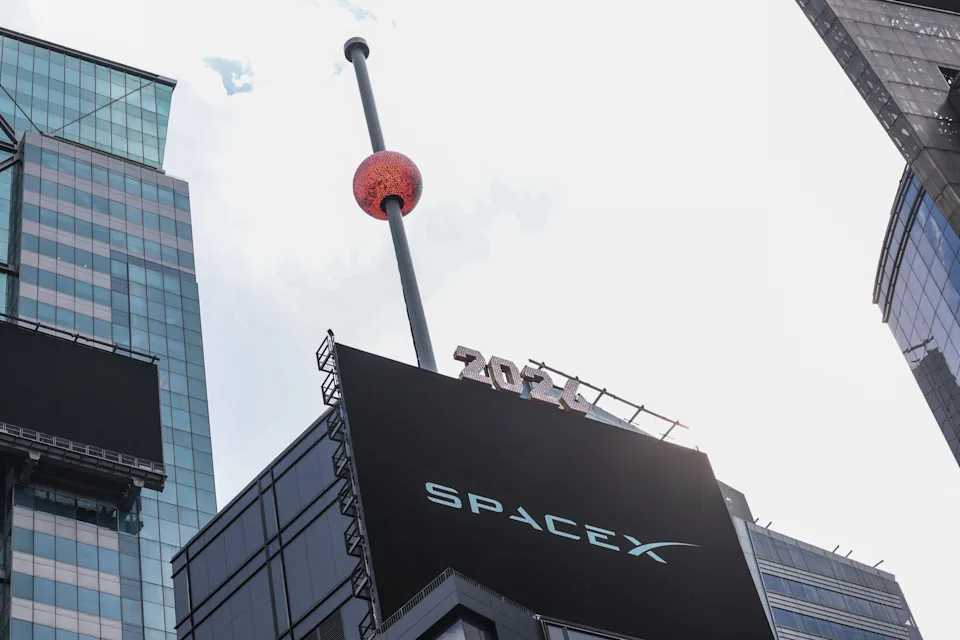 The New Year's eve ball ascends on the day of SpaceX's initial public
offering (IPO) in New York City, U.S., June 12, 2026. REUTERS/Brendan
McDermid
The New Year's eve ball ascends on the day of SpaceX's initial public
offering (IPO) in New York City, U.S., June 12, 2026. REUTERS/Brendan
McDermid
And in the hold-my-beer moment of the day, Brian Gesuale of Raymond James released an $800 price target, writing, "Starship represents the defining industrial innovation of our generation."
Of course, it's not just faith that draws Wall Street.
The underwriters of the SpaceX IPO, according to its S-1 filing, included all of the firms cited above, plus Goldman Sachs (GS), Bank of America (BAC) Securities, and Citigroup (C). In all, there were 17 book-running managers and co-managers of the offering. And while the IPO has passed, if SpaceX's capital needs are as intensive as the analysts predict, there will be plenty more opportunities for Wall Street.
Of those 17 underwriters, at least 12 have released ratings on SpaceX stock. All 12 are the equivalent of a Buy. That's not to say those banks' desire to win SpaceX business in the future motivates their sunny outlooks. There's supposed to be a separation between investment banking and sell-side research.
The rare voices of caution among analysts come from financial institutions and research shops that weren't involved in the IPO. One of them, Nicolas Owens at Morningstar, gently called some of his peers' valuations "a bit fantastical."
Ultimately, faith in Elon Musk comes down to faith that he'll change the world, and in so doing, make people money. Whether churchgoers are a giant asset manager putting billions to work for clients or a father who got an allocation of a few shares for his kids' accounts, the goal is the same.
Will SpaceX fulfill that faith? True believers will have to wait to find out. Consider Elon Musk's other publicly traded company. Tesla (TSLA) sold shares to the public at $17 and started trading on June 29, 2010. They hit a low of about $1.30 a couple of months later, bumped along for years before closing just shy of $30 at the end of 2019, and then really took off beginning in 2020.
So SpaceX devotees would do well to take note of this parenthetical, from the bulls at Goldman Sachs: "SpaceX presents a track record of building toward solutions which many industry experts had previously viewed to be implausible (albeit with this execution not being as linear as public market investors typically desire)."
Julie Hyman is the co-host of Market Domination on Yahoo Finance. You can find her on social media @juleshyman.
Click here for the latest stock market news and in-depth analysis, including events that move stocks
This week top market trends.
-
US hiring falls to just 57,000 in June amid elevated inflation, global turmoil
2026-07-02 :: general :: apnews -
Capita shares tumble as UK withholds payments for missing contract deadlines
2026-07-07 :: stock :: Reuters -
SpaceX stock now enters the post-honeymoon faith phase
2026-07-08 :: stock :: yahoo finance
Recent global market news
-
Federal Reserve policymakers show support for rate hikes as Warsh reins in guidance
2026-06-18 :: :: apnews